On September 16, 2026, an X user asked a question that a lot of parents ask at open enrollment: "I thought you could only max out the family HSA?" The parent who had just posted that their kids each have their own HSA replied: "We do not claim our children as dependents. They are on our insurance because they are under 26, so each can have their own HSA." That's mostly right, with one important correction. What matters isn't whether you do claim your child. What matters is whether anyone can claim them. The Affordable Care Act lets your child stay on your plan until 26 whether or not they're your tax dependent, but the HSA rules in Internal Revenue Code §223 follow the tax-dependent rules. That mismatch is what creates the opportunity, and the traps along with it.
This article covers an adult child (under 26) who is on a parent's family high-deductible health plan (HDHP) for 2027: when that child can open their own Health Savings Account, how much they can put in, who can fund it, and what the parents' own HSA can and can't pay for. It's not a general guide to 2027 HSA contribution limits, choosing an HDHP or PPO, or having an HSA and an FSA in the same household. Those are covered separately.
The Adult-Child HSA in Three Lines
- Who qualifies: A child on your HDHP can contribute to their own HSA only if no one is allowed to claim them as a dependent for that year. Choosing not to claim them isn't enough (IRC §223(b)(6); Form 8889 instructions).
- How much: Your plan covers more than one person, so it's family coverage (IRC §223(c)(4)). The IRS guides don't directly address an adult child's limit. The most widely reported view is that an eligible child can put in up to the full family limit ($9,000 for 2027, $8,750 for 2026), separate from the parents' shared limit, but at least one administrator disagrees. See the limit section below.
- The trade-off: If your child isn't your dependent, your own HSA generally can't pay their medical bills tax-free (IRC §223(d)(2)(A)). Their HSA is the account that pays for their care.
Why the Rules Don't Line Up: ACA Age 26 vs. the Tax Code
Two different laws decide two different questions:
| Question | Which rule answers it | Result for a 22–25-year-old |
|---|---|---|
| Can the child stay on your employer health plan? | ACA dependent coverage rule (29 CFR 2590.715-2714; DOL and CMS FAQs) | Yes, until age 26, whether or not they're married, a student, living with you, or financially dependent on you |
| Is the coverage tax-free to you as the employee? | IRC §§105(b) and 106, as explained in IRS Notice 2010-38 | Yes, for a child who hasn't turned 27 by the end of your tax year, even if they're not your dependent |
| Can the child contribute to their own HSA? | IRC §223(b)(6) (dependent test) | Only if no one can claim them as a dependent for the year |
| Can your HSA pay their medical bills tax-free? | IRC §223(d)(2)(A) (dependent definition, with limited exceptions) | Generally only if they're your dependent. The age-26/27 rules above don't extend to HSAs |
The Department of Labor's young-adult FAQ answers "No" when asked whether plans can limit dependent-child coverage "based upon financial dependency, marital status, enrollment in school, residency or other factors." HealthCare.gov adds that a child can stay on a parent's job-based plan until 26 even if they "aren't claimed as a tax dependent." The ACA also extended the tax exclusion for employer health coverage to children under 27, as IRS Notice 2010-38 explains. That change was made to the §105(b) and §106 rules, though. The HSA reimbursement rule in §223(d)(2)(A) wasn't changed. A Thomson Reuters/EBIA analysis reaches the same conclusion: "similar provisions do not appear in the HSA tax-free reimbursement rules."
Step 1: Can Anyone Claim Your Child as a Dependent?
IRC §223(b)(6) denies an HSA deduction to "any individual with respect to whom a deduction under section 151 is allowable to another taxpayer." The Form 8889 instructions put it plainly: "you cannot deduct contributions if you are someone else's dependent." Publication 969 lists it as an eligibility requirement: an eligible individual "can't be claimed as a dependent on someone else's" return.
The test uses "allowable," so a parent who could claim the child but chooses not to doesn't make the child eligible. Kitces makes the same point. Your child is a dependent if they meet either set of tests below (IRC §152; Publication 501).
Qualifying child tests (all must be met)
| Test | Rule |
|---|---|
| Relationship | Your child, stepchild, foster child, sibling, or a descendant of one of them |
| Age | Under 19 at the end of the year, or a full-time student under 24 at the end of the year, or any age if permanently and totally disabled |
| Residency | Lived with you more than half the year. Time away at school counts as a "temporary absence," so it still counts as living with you |
| Support | The child did not provide more than half of their own support |
| Joint return | The child didn't file a joint return (other than only to claim a refund) |
"Student" means a full-time student during some part of each of any five calendar months of the year (IRC §152(f)(2); Pub. 501). That's why a May graduate who was a full-time student from January through May has met the student test for that whole year.
Qualifying relative tests (all must be met)
If your child isn't your qualifying child (for example, a 24-year-old who isn't a student), they can still be your dependent as a qualifying relative if:
- They're not anyone's qualifying child;
- Their gross income is less than $5,300 for 2026 (the §152(d)(1)(B) exemption amount, Rev. Proc. 2025-32 §4.23). As of October 30, 2026, the IRS has not published the 2027 figure; and
- You provide more than half of their total support for the year.
Important
The dependent test is annual, but HDHP coverage is tested month by month. Section 223(b)(6) looks at whether the child is someone's dependent for the tax year. If your child can still be claimed for 2026 (for example, a 22-year-old who was a full-time student through May 2026), they can't deduct any HSA contribution for 2026, even for months after they started working. They may be eligible starting in 2027.
Quick examples
| Child's situation (tax year) | Can a parent claim them? | Child's own HSA? |
|---|---|---|
| 21, full-time student, lives at home during summers, parents pay tuition and rent | Yes, as a qualifying child (student under 24) | No |
| 22, graduated May 2026, full-time job from July | Yes for 2026, as a qualifying child (student for 5+ months, under 24) | No for 2026. Recheck for 2027 |
| 23 in 2027, not a student, working full time, earns well over the exemption amount | Generally no: fails the qualifying child age test and the qualifying relative gross income test | Yes, if the other HSA conditions are met |
| 25, not a student, earns $3,000, parents provide most support | Likely yes, as a qualifying relative (income below $5,300 for 2026) | No |
| Any age, permanently and totally disabled, meets the other qualifying child tests | Yes (no age limit) | No |
These examples aren't tax advice. Dependency turns on support and residency facts that only you can check, using Pub. 501 and the IRS's Interactive Tax Assistant.
Step 2: The Child Must Be an Otherwise-Eligible Individual
Being a non-dependent isn't enough. Under IRC §223(c)(1) and Pub. 969, your child also needs:
- HDHP coverage on the first day of each month they count. A plan that qualifies for 2027 needs a deductible of at least $1,750 (self-only) / $3,500 (family) and an out-of-pocket maximum no higher than $8,700 / $17,400 (Rev. Proc. 2026-24).
- No disqualifying other health coverage. Watch for:
- The child's own job. If they're also enrolled in their employer's PPO or HMO, that's non-HDHP coverage and it disqualifies them.
- A general-purpose health FSA or HRA that can reimburse their expenses, including yours. Pub. 969 says a parent's health FSA or HRA can reimburse "your child under age 27 at the end of your tax year." The IRS held in Rev. Rul. 2004-45 that general-purpose health FSA or HRA coverage disqualifies an individual, even when a spouse's employer sponsors it. Applying that logic, Thomson Reuters/EBIA concludes: "Adult children whose expenses can be reimbursed by a general-purpose health FSA will also be ineligible to make HSA contributions," and simply not submitting their claims doesn't fix it.
- Medicare (rare at this age, but it applies, for example, with some disabilities).
Important
The FSA trap at open enrollment. If you're electing a general-purpose health FSA for 2027 (the 2026 salary-reduction limit is $3,400 under Rev. Proc. 2025-32; the IRS hadn't published the 2027 figure as of October 30, 2026), ask HR whether it can be limited-purpose (dental and vision) or limited to your own expenses. Otherwise your adult child may lose HSA eligibility for the whole plan year. Pub. 969 also notes that a general-purpose FSA grace period with a non-zero balance can affect HSA eligibility.
Step 3: How Much Can the Child Contribute in 2027?
Your HDHP covers you and at least one other person, so it's family coverage. The statute defines family coverage as "any coverage other than self-only coverage" (§223(c)(4)), and Pub. 969 says family HDHP coverage covers an eligible individual "and at least one other individual (whether or not that individual is an eligible individual)." Your child is covered by that plan, so the child's own contribution limit is based on family coverage.
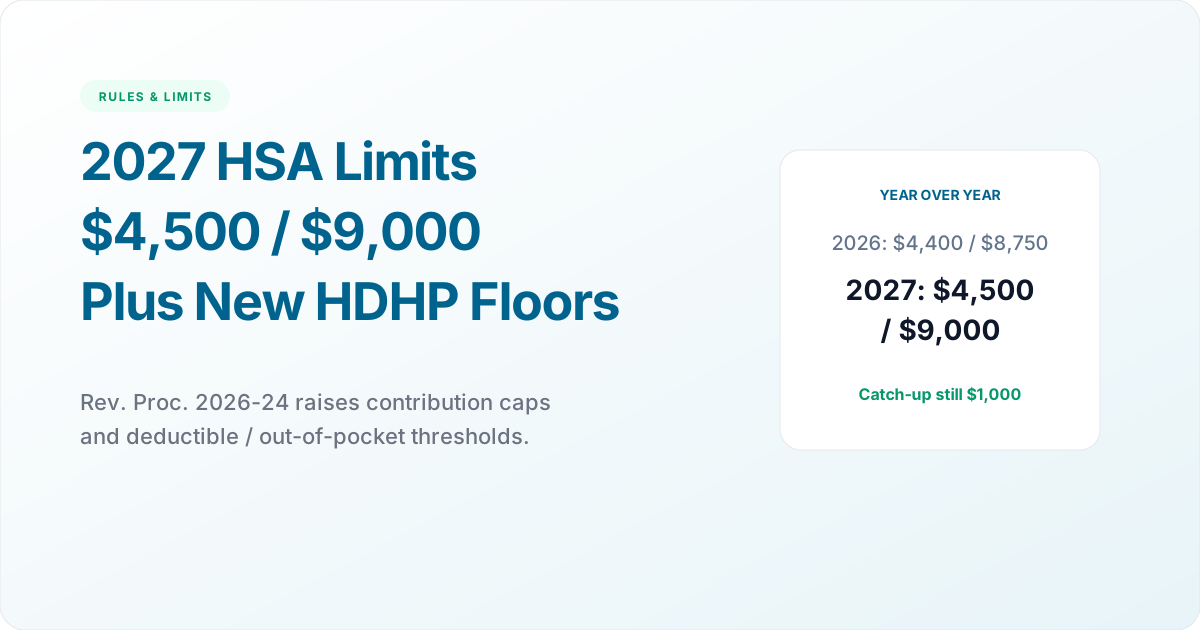
| Item | 2026 (Rev. Proc. 2025-19) | 2027 (Rev. Proc. 2026-24) |
|---|---|---|
| Family HSA contribution limit | $8,750 | $9,000 |
| Self-only HSA contribution limit | $4,400 | $4,500 |
| HDHP minimum deductible (self-only / family) | $1,700 / $3,400 | $1,750 / $3,500 |
| HDHP out-of-pocket maximum (self-only / family) | $8,500 / $17,000 | $8,700 / $17,400 |
The $1,000 age-55 catch-up (IRC §223(b)(3)) won't apply to a child under 26.
Does the child's contribution reduce the parents' family limit?
The IRS hasn't published direct guidance on this. Here's what the law and the sources say:
- The statute's sharing rule covers spouses only. IRC §223(b)(5) makes "individuals who are married to each other" split one family limit. Nothing in §223 tells a parent and a non-dependent child to share.
- Ascensus, a major HSA trustee, wrote in May 2025 that "there is no official guidance," but that "an IRS official commented to Ascensus" that "a separate family contribution limit ... would apply to the child." The parents would still share their own family limit.
- Kitces and several employer plan guides take the same separate-limit view. For example, Brookhaven National Laboratory's "HSA Road Rules" says the adult child can contribute up to the family maximum and that this doesn't reduce the parents' limit.
- American Fidelity (March 2026) agrees the child can contribute up to the family limit, but then says "the total contributions across all HSAs within the family plan cannot exceed the family limit," which is the conservative view.
What this means for you: The separate-limit position rests on the statute's text and on informal IRS comments reported by a trustee. It isn't a published ruling. If you want zero risk, keep the household total at one family limit. If you want to use the separate limit, have a tax professional sign off and keep records showing the child's non-dependent status.
Partial-year situations
HSA limits are figured month by month (IRC §223(b)(2)), with the last-month rule as an exception.
- Turning 26 in 2027: Job-based coverage usually ends at 26 (CMS turning-26 guide). Marketplace plans keep a child through December 31 of the year they turn 26 (HealthCare.gov). Ask your plan what its exact end date is. Example: your child is eligible on the first of January through June under your family HDHP, then on their own self-only HDHP from July through December. The Form 8889 Line 3 worksheet gives 6/12 × $9,000 + 6/12 × $4,500 = $6,750. Since they're eligible on December 1 with self-only coverage, the alternative is $4,500. Pub. 969 lets them use the greater of the two, so $6,750.
- Becoming eligible late in the year: Under the last-month rule, someone eligible on December 1 can contribute the full-year limit, but must then stay eligible through a testing period that runs to December 31 of the following year. Failing it means income tax plus a 10% additional tax on the extra amount (IRC §223(b)(8); Form 8889 Part III). See our last-month rule guide.
- Deadline: Contributions for 2027 can be made until the unextended due date of the 2027 return (generally April 15, 2028). Contributions for 2026 can be made until April 15, 2027 (Pub. 969; Form 8889 instructions).
Step 4: Who Puts the Money In, and Who Gets the Deduction
- Anyone can contribute. Pub. 969: "Family members or any other person may also make contributions on behalf of an eligible individual." Parents, grandparents, or the child can all fund it. Contributions must be made in cash, not stock.
- The child takes the deduction. The HSA belongs to the child, so the child reports all contributions on their own Form 8889 and deducts them, "even if you don't itemize" (Pub. 969). That includes money you gave them. The parents don't get a deduction for it.
- Not through your payroll. Your cafeteria plan pre-tax deferral funds your HSA. American Fidelity notes that the parent "cannot use pre-tax salary reductions to contribute to the adult child's HSA." If your child's own employer offers HSA payroll deposits but the child is on your HDHP instead of that employer's plan, ask the employer whether it allows HSA deferrals for employees who aren't on its health plan.
- Opening the account. The child opens an HSA at any trustee or custodian that accepts individual accounts. It doesn't have to be through your employer. Tell the trustee the coverage type is family.
Step 5: What Your Own HSA Can (and Can't) Pay For
IRC §223(d)(2)(A) limits tax-free HSA distributions to expenses of the account holder, a spouse, and "any dependent (as defined in section 152, determined without regard to subsections (b)(1), (b)(2), and (d)(1)(B))." Pub. 969 translates that: your HSA can pay for "all dependents you claim" and "any person you could have claimed as a dependent ... except that" they filed a joint return, had gross income at or above the exemption amount, or you could be claimed as someone else's dependent.
| Your adult child is... | Your HSA pays their bills tax-free? | Their own HSA? |
|---|---|---|
| Your qualifying child (e.g., a full-time student under 24) | Yes | No (they can be claimed) |
| Your qualifying relative (income below the exemption amount, you provide over half of support) | Yes | No |
| Fails only the gross income test (you provide over half of support, but they earn $5,300+ in 2026) | Yes, because §223(d)(2)(A) disregards the gross income test | Yes, if otherwise eligible (they can't be claimed) |
| Self-supporting and not a dependent under any test | No. A distribution is taxable plus a 20% additional tax (IRC §223(f)(4)) | Yes, if otherwise eligible |
The third row is a narrow case most articles skip. It comes straight from the statute's cross-reference and from Pub. 969's list. Keep records of support if you rely on it.
Pub. 969 also says that for this purpose, a child of divorced, separated, or living-apart parents is treated as the dependent of both parents, whichever parent claims the child.
Step 6: The Child's Own HSA Pays From the Date It's Opened
Pub. 969 says HSA distributions are tax-free only for qualified medical expenses incurred after the HSA is established. If your child becomes eligible in January 2027 but doesn't open the account until June, a February ER bill can't be reimbursed tax-free from the new HSA. They can still make the full year's contribution by April 2028 (subject to the month-by-month rules). Open the account as soon as the child is eligible, even with a small deposit.
Open Enrollment Checklist for Families With Adult Children
If You Get It Wrong
- Child contributed but could be claimed as a dependent: The contributions aren't deductible and are excess contributions subject to a 6% excise tax each year they remain (IRC §4973). Withdraw the excess and its earnings by the tax-filing deadline (including extensions) to avoid the 6% tax. See how to fix an excess HSA contribution and ineligible contributions.
- You paid a non-dependent child's bills from your HSA: That distribution is taxable and, before age 65, subject to the 20% additional tax unless an exception applies. IRS Notice 2004-50 (Q&A-37) lets you repay a mistaken distribution only if there's "clear and convincing evidence" it resulted from "a mistake of fact due to reasonable cause," and trustees aren't required to accept the repayment (Q&A-76). Misreading the dependent rules may not qualify, so ask your trustee and a tax professional.
Frequently Asked Questions
Related Articles
- HSA Contribution Limits for 2027: Full 2027 limits, catch-up contributions, and HDHP thresholds
- The HSA Last-Month Rule: How the testing period works if you become eligible mid-year
- HSA and FSA at the Same Time: Limited-purpose FSAs and household FSA conflicts
- Fixing Ineligible HSA Contributions: What to do if you contributed while ineligible
- Excess HSA Contribution Fix: Withdrawing excess contributions before the 6% tax
- HDHP vs PPO for 2027 Open Enrollment: Five-number test to pick the cheaper plan
Sources
IRS Primary Sources:
- Internal Revenue Code §223 (HSAs: §223(b)(2), (b)(5), (b)(6), (b)(8), (c)(1), (c)(4), (d)(2)(A), (f)(4)): https://www.law.cornell.edu/uscode/text/26/223
- Internal Revenue Code §152 (dependent defined: qualifying child and qualifying relative): https://www.law.cornell.edu/uscode/text/26/152
- Revenue Procedure 2026-24 (2027 HSA and HDHP limits): https://www.irs.gov/pub/irs-drop/rp-26-24.pdf
- Revenue Procedure 2025-19 (2026 HSA and HDHP limits): https://www.irs.gov/pub/irs-drop/rp-25-19.pdf
- Revenue Procedure 2025-32 (2026 §152(d)(1)(B) exemption amount $5,300 and health FSA limit $3,400): https://www.irs.gov/pub/irs-drop/rp-25-32.pdf
- Publication 969 (2025), Health Savings Accounts and Other Tax-Favored Health Plans: https://www.irs.gov/publications/p969
- Instructions for Form 8889 (2025): https://www.irs.gov/pub/irs-pdf/i8889.pdf
- Publication 501 (2025), Dependents, Standard Deduction, and Filing Information: https://www.irs.gov/publications/p501
- IRS Notice 2010-38 (exclusion for children under age 27): https://www.irs.gov/pub/irs-drop/n-10-38.pdf
- Revenue Ruling 2004-45 (health FSA or HRA coverage and HSA eligibility): https://www.irs.gov/pub/irs-drop/rr-04-45.pdf
- IRS Notice 2004-50, Q&A-37 and Q&A-76 (mistaken distributions), Internal Revenue Bulletin 2004-33: https://www.irs.gov/irb/2004-33_IRB
- IRS Interactive Tax Assistant, "Whom May I Claim as a Dependent?": https://www.irs.gov/help/ita/whom-may-i-claim-as-a-dependent
HHS / CMS / DOL Sources:
- HealthCare.gov, "Health insurance coverage for children and young adults under 26": https://www.healthcare.gov/young-adults/children-under-26/
- CMS, "Turning 26?" consumer guide: https://www.cms.gov/marketplace/outreach-and-education/turning-26.pdf
- CMS CCIIO, Young Adults and the Affordable Care Act FAQ: https://www.cms.gov/cciio/resources/files/adult_child_faq
- U.S. Department of Labor EBSA, Young Adults and the ACA FAQs: https://www.dol.gov/agencies/ebsa/about-ebsa/our-activities/resource-center/faqs/young-adult-and-aca
- 29 CFR 2590.715-2714 (dependent coverage of children to age 26): https://www.ecfr.gov/current/title-29/subtitle-B/chapter-XXV/subchapter-L/part-2590/subpart-C/section-2590.715-2714
Trustee, Administrator, and Professional Sources:
- Ascensus, "How HSA Contributions can be Split Between Family Members" (May 2025): https://thelink.ascensus.com/articles/2025/5/12/how-can-hsa-contributions-be-split-between-family-members
- Ascensus, "HDHP Family Coverage and the HSA Contribution Limit" (Jan. 2020): https://thelink.ascensus.com/articles/2020/1/15/hdhp-family-coverage-and-the-hsa-contribution-limit
- Thomson Reuters / EBIA, "Can an Adult Child's Medical Expenses Be Reimbursed Tax-Free From a Parent's HSA?" (Mar. 2023): https://tax.thomsonreuters.com/blog/can-an-adult-childs-medical-expenses-be-reimbursed-tax-free-from-a-parents-hsa/
- Thomson Reuters / EBIA, "Will Employees' Participation in Our Company's Health FSA Prevent Their Spouses or Adult Children From Contributing to an HSA?" (Sept. 2022): https://tax.thomsonreuters.com/blog/will-employees-participation-in-our-companys-health-fsa-prevent-their-spouses-or-adult-children-from-contributing-to-an-hsa/
- Kitces, HSAs for dependents and children up to age 26: https://www.kitces.com/blog/health-savings-accounts-hsa-dependents-children-age-26-hdhp-taxes-contribution-limits/
- HealthEquity, "Are my spouse and adult children covered by my HSA/FSA?" (updated June 2026): https://www.healthequity.com/library/hsa-fsa-coverage-spouse-adult-children
- American Fidelity, "How Does an HSA Work? Mistakes to Avoid with Dependent Rules" (Mar. 2026): https://americanfidelity.com/blog/reimburse/hsa-mistakes-dependents
- Brookhaven National Laboratory, "HSA Road Rules": https://www.bnl.gov/hr/benefits/docs/medical/hsa_roadrules.pdf
Social Media References:
- X post by @NFinTX (Sept. 16, 2026): https://x.com/NFinTX/status/2100316616600809841
- X reply by @PunkyCovfefe (Sept. 16, 2026): https://x.com/PunkyCovfefe/status/2100317862833381736
Written by
Michael is a Certified Public Accountant and IRS Enrolled Agent who has spent 12 years helping individuals and businesses navigate tax-advantaged health accounts. He leads HSA Orbit's tax strategy content.