Every fall the same question floods r/personalfinance and r/HealthInsurance: "HDHP with an HSA or the PPO - which one should I pick?" The usual answers ("HDHP if you're healthy, PPO if you're sick") are too vague to act on, and they are sometimes flat wrong. The real answer to HDHP vs PPO comes from five numbers that are already sitting in your open enrollment portal. This guide shows you which five, how to combine them, and how to sanity-check the result before your enrollment window closes.
If you want to plug your own plan details in while you read, open the HDHP vs PPO calculator in another tab. For the 2027 numbers behind the HSA side of the comparison, see HSA contribution limits for 2027.
The Short Answer
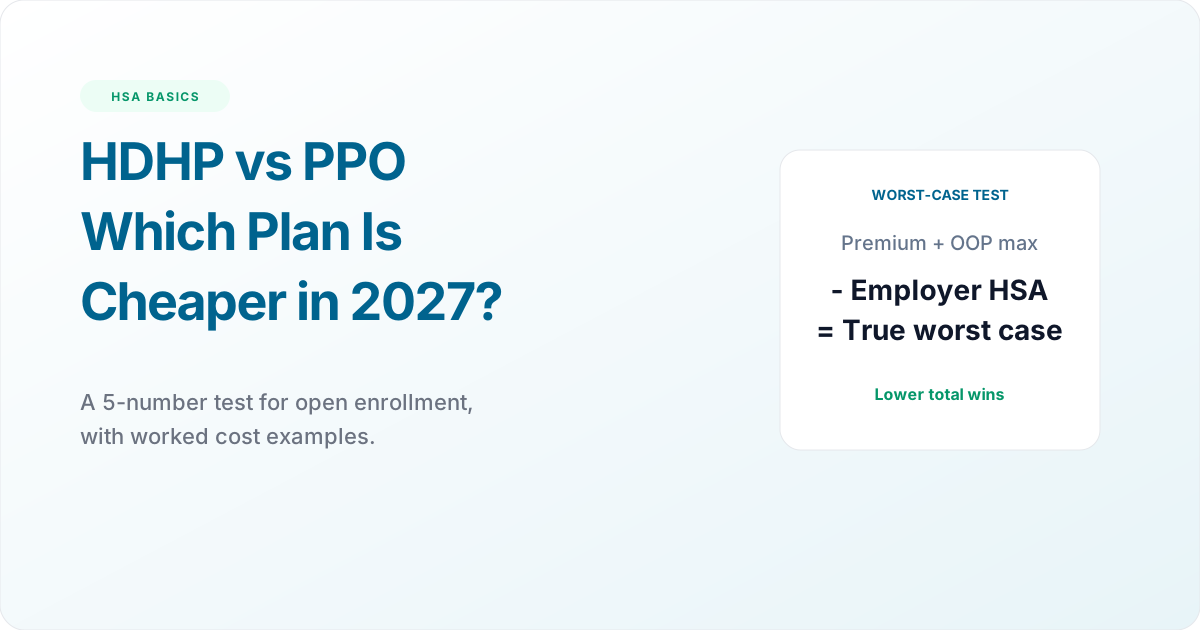
- Compare worst-case total cost first: annual premium + out-of-pocket maximum, minus any employer HSA money.
- If the HDHP is cheaper even in the worst case, it is cheaper in every case - pick it, as long as you can cash-flow the deductible.
- If the PPO is cheaper in the worst case, run a "typical year" estimate before deciding.
- Your own HSA contributions add a tax discount on top - but only if you will actually make them.
Why This Question Is So Hard (and Why Generic Advice Fails)
The HDHP vs PPO decision feels hard because you are choosing a price structure for a year you cannot predict. A PPO front-loads cost into premiums and makes care cheaper when you use it. A high deductible health plan (HDHP) does the opposite: lower premiums, more cost when you use care, and access to a Health Savings Account (HSA).
Generic advice fails because employers price these plans very differently. Some employers subsidize the HDHP heavily and add a generous HSA deposit; others barely discount it. One recent r/HealthInsurance poster discovered that her employer's HDHP premium was actually higher than the PPO's - which flips the usual logic on its head. Another r/personalfinance poster found the HDHP cheaper by thousands of dollars even if his family maxed out every benefit. Same two plan types, opposite answers.
That is why the right move is to stop asking "which plan type is better?" and start asking "which of my two plans costs less under realistic and worst-case scenarios?"
Step 1: Confirm the HDHP Is Actually HSA-Eligible for 2027
Before you do any math, make sure the "HSA plan" really qualifies. An HSA is only available if you are covered by a qualifying HDHP and have no disqualifying other coverage. For calendar year 2027, Rev. Proc. 2026-24 sets these thresholds:
The key 2027 tests:
- Minimum annual deductible: $1,750 self-only / $3,500 family
- Maximum out-of-pocket: $8,700 self-only / $17,400 family
- For comparison, 2026 plans used $1,700 / $3,400 minimum deductibles and $8,500 / $17,000 out-of-pocket caps (Rev. Proc. 2025-19)
Important
Red flag: If a plan labeled "HSA plan" shows a deductible below $1,750 self-only for 2027, ask HR before you enroll. Reddit commenters regularly catch plans with deductibles under the IRS floor. If the plan does not qualify, contributions made to an HSA while covered by it are ineligible contributions. See how to fix ineligible HSA contributions.
Also check the people around you. If your spouse enrolls in a general-purpose health FSA at their job, that FSA can cover your expenses and make you ineligible for HSA contributions - a common surprise that the HSA and FSA at the same time guide walks through. Enrolling in Medicare also ends contribution eligibility; see Medicare Part A and HSA eligibility.
You can run a quick check with the HSA eligibility checker.
Step 2: Pull the Five Numbers From Your Benefits Portal
For each plan, write down these five numbers for your coverage tier (self-only, employee + spouse, family):
- Your annual premium - your paycheck deduction multiplied by pay periods (26 for biweekly, 24 for semimonthly, 12 for monthly).
- Deductible - the in-network amount you pay before coinsurance kicks in.
- Coinsurance - your share after the deductible (for example 20%).
- Out-of-pocket maximum - the most you pay for covered in-network care in the plan year.
- Employer HSA contribution - the HDHP-only deposit your employer adds (often $500 to $1,500, but it varies widely, and some employers give nothing).
Pro Tip
Pro tip: Use the plan's Summary of Benefits and Coverage (SBC). Every plan must provide one, and it lists the deductible, out-of-pocket limit, and coinsurance in a standard format, so you are comparing apples to apples.
Step 3: Run the Worst-Case Test First
This is the single most useful calculation, and it takes about thirty seconds:
Worst-case cost = annual premium + out-of-pocket maximum - employer HSA contribution
Do it for both plans. Whichever number is lower is the plan that protects you better in a bad year (surgery, hospitalization, a new diagnosis, or a pregnancy).
Now the shortcut: if the HDHP's worst case is lower than the PPO's worst case, the HDHP generally wins in a low-use year too, because its premiums are lower and you have not used care yet. In that situation the HDHP comes out ahead across nearly every scenario, and the rest of the decision is about cash flow, not cost.
If the PPO's worst case is lower, the answer depends on how much care you expect. Move on to Step 4.
Step 4: Model Three Realistic Years
Estimate your total cost under three levels of use. A simple version:
- Low year: preventive care plus one or two sick visits. Preventive care is generally covered before the deductible on HSA-qualified HDHPs, so a checkup alone usually costs little or nothing.
- Medium year: a few specialist visits, some lab work, regular prescriptions - something like what you spent last year.
- High year: you hit the out-of-pocket maximum.
For each year: premium + what you pay for care - employer HSA money. Your claims history from your insurer's website is the best source for the "medium" estimate.
A Worked Example (Self-Only, 2027 Plan Year)
The plan figures below are a hypothetical illustration, not real plan pricing. Swap in your own numbers.
| | PPO | HDHP + HSA | | --- | --- | --- | | Your annual premium | $1,800 ($150/mo) | $720 ($60/mo) | | Deductible | $750 | $2,000 | | Coinsurance after deductible | 20% | 20% | | Out-of-pocket maximum | $4,000 | $5,000 | | Employer HSA deposit | $0 | $750 |
The HDHP's $2,000 deductible clears the 2027 $1,750 floor, and its $5,000 out-of-pocket maximum is under the $8,700 cap, so it qualifies.
Low year - $500 of care (all below both deductibles):
- PPO: $1,800 + $500 = $2,300
- HDHP: $720 + $500 - $750 = $470
Medium year - $3,000 of care:
- PPO: $750 deductible + 20% of $2,250 ($450) = $1,200 of care cost. Total $1,800 + $1,200 = $3,000
- HDHP: $2,000 deductible + 20% of $1,000 ($200) = $2,200 of care cost. Total $720 + $2,200 - $750 = $2,170
High year - you hit the out-of-pocket maximum:
- PPO: $1,800 + $4,000 = $5,800
- HDHP: $720 + $5,000 - $750 = $4,970
In this example the HDHP wins all three years. The worst-case test would have told you that immediately: the HDHP's out-of-pocket maximum is $1,000 higher, but you save $1,080 in premiums and get $750 from your employer - $1,830 of advantage that more than covers the $1,000 gap.
Real plans also use flat copays for office visits and prescriptions on PPOs, which this simple model skips. If you take expensive brand-name drugs or see specialists monthly, add those copays explicitly. The HDHP vs PPO calculator models copays separately.
Step 5: Add the HSA Tax Discount (Only If You Will Actually Contribute)
The comparison above ignores your own HSA contributions. Those carry a real tax benefit: money you put into an HSA through payroll is generally excluded from federal income tax and, when made through your employer's cafeteria plan, from Social Security and Medicare taxes (7.65% for most employees). Withdrawals for qualified medical expenses are tax-free, and the balance can be invested. That is the triple tax advantage.
Continuing the example: suppose you are in the 22% federal bracket and contribute $2,000 of your own money through payroll in 2027.
- Approximate tax savings: $2,000 x (22% + 7.65%) = about $593
- HDHP low year becomes $470 - $593 = roughly $123 better than free
- HDHP medium year: $2,170 - $593 = $1,577
- HDHP high year: $4,970 - $593 = $4,377
For 2027 you can contribute up to $4,500 self-only or $9,000 family, minus whatever your employer deposits, plus a $1,000 catch-up if you are 55 or older (2026 limits were $4,400 and $8,750). Employer money counts toward the same cap - in the example, the most you could add yourself is $4,500 - $750 = $3,750. Estimate your own number with the HSA contribution calculator.
Important
State tax caveat: California and New Jersey do not follow the federal HSA exclusion, so residents still owe state income tax on contributions. Use your federal rate plus FICA only. See the California HSA tax guide and New Jersey HSA tax guide.
Good to Know
Be honest here. If your budget will not allow HSA contributions, leave the tax discount out of the comparison. The HDHP still wins or loses on premiums, out-of-pocket costs, and employer money alone - and many people choose it for those reasons even without contributing.
When the PPO Is the Better Choice
The HDHP does not always win. The PPO tends to come out ahead when:
- The premium gap is small or reversed. If the HDHP saves you only a few hundred dollars a year in premiums and the employer adds little or nothing to the HSA, the PPO's lower deductible can outweigh it.
- You have predictable, ongoing costs below the deductible. Monthly specialist visits or a pricey maintenance prescription with a flat PPO copay can cost much less than paying the full negotiated rate until an HDHP deductible is met.
- The PPO's out-of-pocket maximum is far lower. If the PPO caps your exposure several thousand dollars lower and the premium savings do not make up the gap, the PPO is the safer pick in a year you expect heavy use, like a planned surgery or pregnancy.
- You cannot cover the deductible in cash. An HDHP that is cheaper on paper is not cheaper if a $2,000 bill goes on a credit card at 25% APR. If you have no emergency fund and no HSA balance yet, factor in that risk.
- The networks differ. Cost math means nothing if your doctor or hospital is in-network only on one plan. Always check provider directories and the drug formulary.
When the HDHP + HSA Is the Better Choice
The HDHP usually wins when:
- The worst-case test favors it (the clearest signal).
- Your employer contributes to the HSA. That deposit is free money that only HDHP enrollees receive.
- You expect low to moderate use and preventive care makes up most of your visits.
- You can contribute and invest. Over many years, an invested HSA can become a dedicated retirement health fund. See investing your HSA for the long term and using an HSA for retirement.
- You are a heavy user, but the HDHP's worst case is lower. Counterintuitively, people who expect to hit the out-of-pocket maximum sometimes do better on the HDHP if its premiums are much lower - as one Reddit family found when the HDHP beat a $0-deductible PPO by thousands.
Special Situations to Check Before You Click "Enroll"
Married Couples on Different Employer Plans
If one spouse picks an HDHP and the other picks a PPO that covers the whole family, the HDHP spouse may lose HSA eligibility, because the PPO is disqualifying other coverage. Decide together, and compare family coverage on each employer's plan, not just each person's own option.
Switching Plans Mid-Year
Open enrollment changes usually take effect January 1. If you change coverage mid-year because of a qualifying life event, your HSA limit may be prorated by months of eligibility - or you may be able to use the last-month rule. See the HSA last-month rule guide.
Keeping an HSA After You Switch Back to a PPO
Picking a PPO for 2027 does not cost you your existing HSA. The money stays yours, and you can keep spending it tax-free on qualified expenses - you just cannot add new contributions for months you are not HSA-eligible. See keeping an HSA without an HDHP. Stop payroll contributions effective January 1 if you switch.
Health FSA Elections
If you pick the HDHP, do not also sign up for a general-purpose health FSA - that would make you ineligible to contribute to the HSA. A limited-purpose (dental and vision) FSA is generally compatible. Compare the options in HSA vs FSA.
Your Open Enrollment Checklist
Frequently Asked Questions
Bottom Line
You do not need to predict next year's health to win the HDHP vs PPO decision. Pull five numbers, run the worst-case test, model a typical year, and add the HSA tax discount only if you will really contribute. When the HDHP is cheaper even in the worst case, it is the clear pick for most people who can cover the deductible. When it is not, let your expected care, your network, and your cash cushion decide. Then plug your final numbers into the HDHP vs PPO calculator and set your 2027 HSA contribution with the contribution calculator.
Primary IRS sources: Rev. Proc. 2026-24 (2027 limits); Rev. Proc. 2025-19 (2026 limits); Publication 969.
Written by
David is a licensed attorney and SHRM Senior Certified Professional who covers HSA compliance, IRS regulations, and employer benefits law. He previously practiced employee benefits law at a national firm.