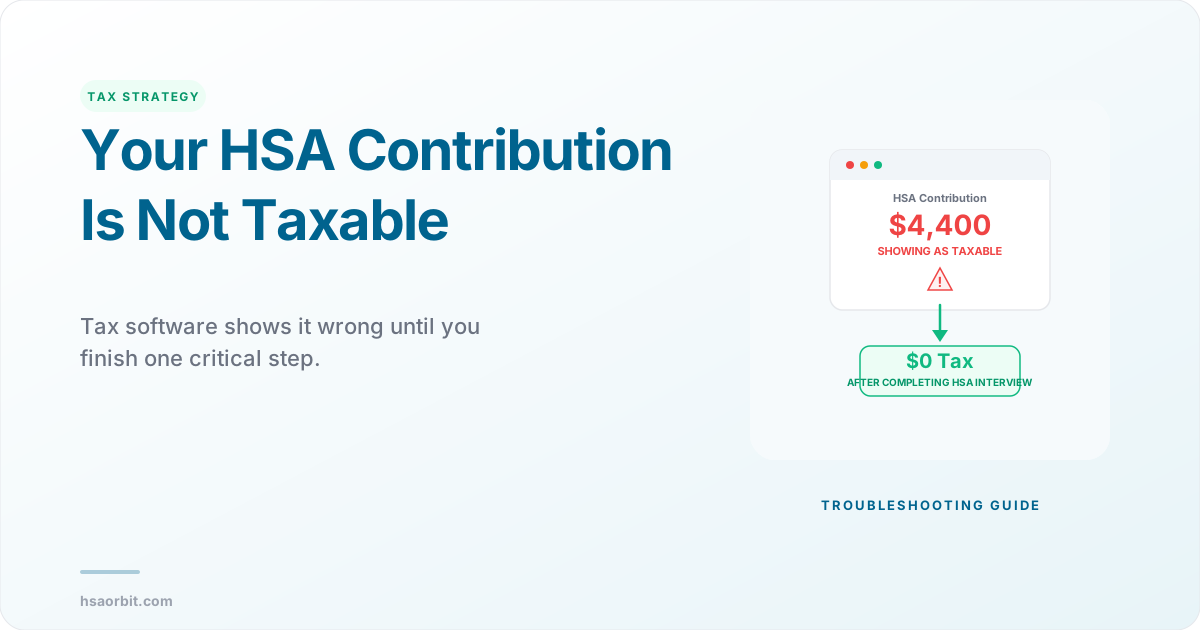
If you made an ineligible HSA contribution, you are not alone, and the problem is fixable. Every year, thousands of people contribute to a Health Savings Account only to discover they were not eligible for part or all of the year. Maybe you lost your HDHP coverage mid-year, enrolled in Medicare, or did not realize your spouse's FSA disqualified you. Whatever the reason, the IRS expects you to correct the mistake. Leave it unresolved and you face a 6% excise tax that compounds every single year the excess stays in your account. This guide walks you through every scenario, every correction path, and every form you need to file.
Important
Time-sensitive: If this applies to your 2025 tax year, you have until April 15, 2026 to withdraw ineligible contributions and avoid the 6% excise tax entirely. File for an extension and that deadline moves to October 15, 2026.
Why Your HSA Contribution May Be Ineligible
An HSA contribution is ineligible when you make it during a month you do not meet all four IRS eligibility requirements. According to IRS Publication 969, you must be:
- Covered under a qualifying high-deductible health plan (HDHP)
- Not enrolled in Medicare (Part A or Part B)
- Not claimed as a dependent on someone else's tax return
- Not covered by a disqualifying health plan (such as a general-purpose FSA or HRA)
You must meet all four requirements on the first day of each month for that month to count as an eligible month. One month of ineligibility means your annual contribution limit must be prorated - and any amount above the prorated limit becomes an excess contribution subject to the 6% excise tax under IRC Section 4973.
For 2025, the HSA contribution limit is $4,300 for self-only HDHP coverage and $8,550 for family coverage, plus an additional $1,000 catch-up contribution if you are 55 or older. For 2026, those limits rise to $4,400 (self-only) and $8,750 (family).
The 8 Most Common Ineligible HSA Contribution Scenarios
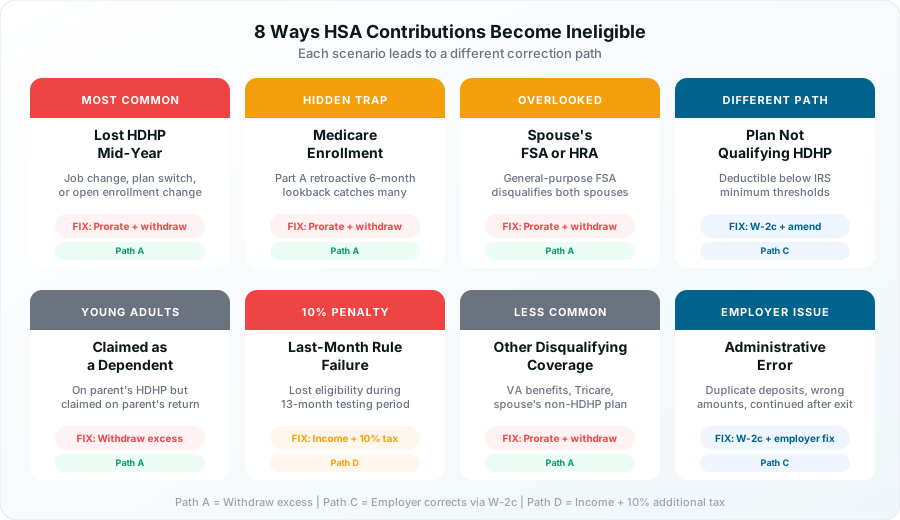
Understanding which scenario applies to you determines the exact fix. Here is every major way people end up with ineligible contributions.
1. Lost HDHP Coverage Mid-Year
You changed jobs and your new employer offers only a PPO. Or you switched from an HDHP to a traditional plan during open enrollment, but payroll deductions kept going. Your HSA contribution limit must be prorated: divide the annual limit by 12 and multiply by the number of months you were eligible.
Example: Marcus had family HDHP coverage from January through August (8 months), then switched to a PPO. His prorated limit is $8,550 x 8/12 = $5,700. He contributed $7,000 through payroll by August. His excess is $1,300.
2. Medicare Enrollment
Once you enroll in Medicare Part A or Part B, your HSA contribution limit drops to zero for those months. The critical trap most people miss: Medicare Part A can be retroactively effective up to six months before your application date. If you apply for Social Security benefits at age 65, your Medicare Part A enrollment may be backdated six months, turning contributions you thought were valid into excess contributions overnight.
According to the Journal of Accountancy, the safest approach is to stop HSA contributions six months before you plan to apply for Medicare.
Pro Tip
Planning ahead? If you are approaching 65, stop HSA contributions six months before your Medicare application date. This prevents the retroactive enrollment from creating excess contributions.
3. Spouse's General-Purpose FSA or HRA
This is the scenario that blindsides married couples. If your spouse enrolls in a general-purpose Health FSA or HRA through their employer, it disqualifies both of you from making HSA contributions - even if you have your own HDHP. The FSA does not need to cover you directly. Its existence in your household is enough.
The exception: a limited-purpose FSA (dental and vision only) or a post-deductible HRA does not disqualify you. Check with your spouse's employer to confirm which type of FSA or HRA they have.
4. Your HDHP Did Not Actually Qualify
Some employer plans are labeled "HDHP" but do not meet the IRS deductible minimums. For 2025, a qualifying HDHP must have a minimum deductible of $1,650 (self-only) or $3,300 (family), and out-of-pocket maximums cannot exceed $8,300 (self-only) or $16,600 (family). If your plan's deductible falls below these thresholds, the HSA was never validly established, and a different correction path applies (see Path C below).
5. Claimed as a Dependent
If you are under 26 and on a parent's HDHP, you can open your own HSA - but only if you are not claimed as a dependent on your parent's tax return. Many young adults miss this nuance and contribute to an HSA while their parents still claim them.
6. Last-Month Rule Testing Period Failure
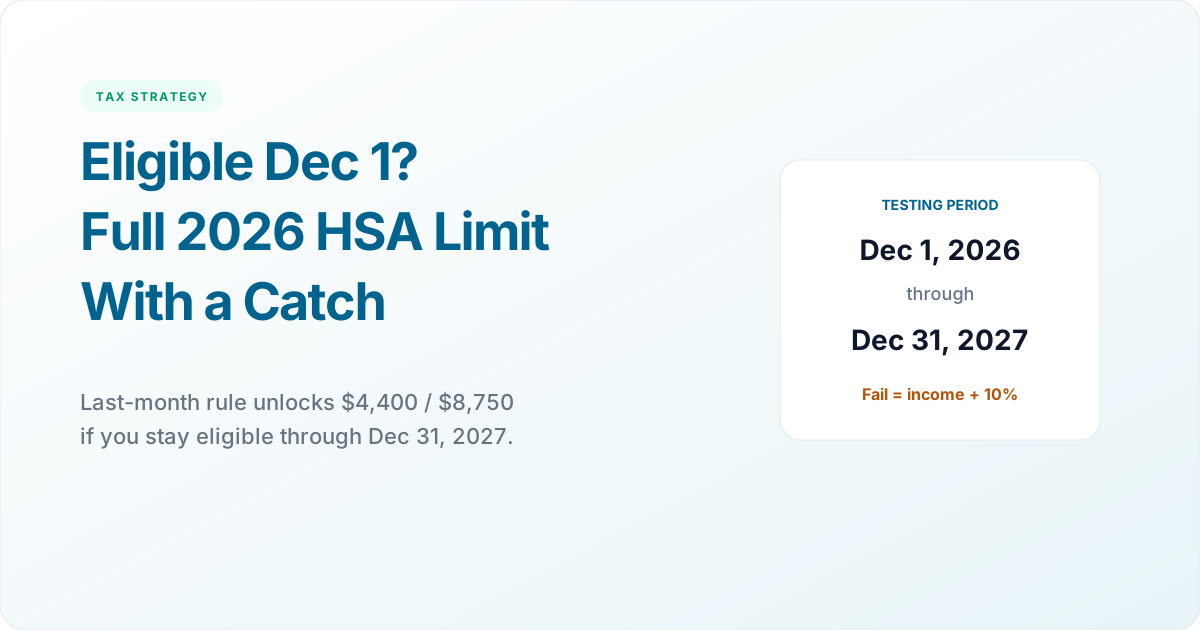
The last-month rule lets you contribute the full annual amount if you are eligible on December 1. But you must remain eligible through December 31 of the following year (the testing period). Lose eligibility during the testing period and you owe income tax on the excess plus a 10% additional tax - not the 6% excise tax.
7. Other Disqualifying Health Coverage
VA benefits received in the prior three months, Tricare coverage, and Indian Health Service coverage all disqualify you. So does being covered under a spouse's non-HDHP plan that provides general medical coverage.
8. Employer Administrative Errors
Your employer kept deducting HSA contributions after you became ineligible, sent duplicate payroll transmissions, or started contributions before your HDHP waiting period ended. According to Newfront's guide on mistaken HSA contributions, employers have specific correction options, including requesting a return from the HSA custodian and issuing a corrected W-2c.
What Happens If You Contribute to an HSA Without HDHP Coverage
The consequences depend on how long the excess stays in your account.
If you catch it before the tax deadline: You can withdraw the excess plus any earnings it generated and owe zero excise tax. The withdrawn earnings are taxable income, but the excess contribution itself is not (since it was never deductible). This is the best outcome.
If you miss the deadline: The 6% excise tax hits, calculated on Form 5329, Part VII. Worse, it recurs every year the excess remains in the account.
| Year | Excess Balance | Excise Tax (6%) | Cumulative Penalty |
|---|---|---|---|
| 2025 (Year 1) | $2,000 | $120 | $120 |
| 2026 (Year 2) | $2,000 | $120 | $240 |
| 2027 (Year 3) | $2,000 | $120 | $360 |
| 2028 (Year 4) | $2,000 | $120 | $480 |
| 2029 (Year 5) | $2,000 | $120 | $600 |
A $2,000 mistake costs $600 in penalties over five years - 30% of the original excess - plus you still owe income tax on the amount when you eventually take it out. The math only gets worse from there.
How to Fix an Ineligible HSA Contribution Before the Tax Deadline
There are three distinct correction paths depending on your situation. Use the right one or you risk making the problem worse.
Path A: Withdraw Excess Before the Deadline (Most Common)
This is the preferred fix for anyone who was eligible for part of the year but over-contributed beyond their prorated limit.
Step 1: Calculate your prorated contribution limit. Use the Form 8889 Line 3 Limitation Chart to determine how many months you were eligible. Divide the annual limit by 12 and multiply by your eligible months. Subtract any employer contributions shown on your W-2 Box 12 Code W.
Step 2: Contact your HSA custodian. Request a "Return of Excess Contribution" - this is a specific distribution type, not a regular withdrawal. Your custodian will calculate the net income attributable (NIA) to the excess, which must also be withdrawn. According to Fidelity, most custodians have a dedicated form for this process.
Step 3: Complete the withdrawal before your tax deadline. For 2025 contributions, the deadline is April 15, 2026 (or October 15, 2026 if you file an extension). If you already filed without withdrawing, you have up to six months after the original due date to withdraw and file an amended return. Write "Filed pursuant to section 301.9100-2" at the top of the amendment.
Step 4: Report correctly on your tax return. The excess contribution itself is not taxable when withdrawn (you could not deduct it anyway). The withdrawn earnings are taxable as other income. Report the withdrawal on Form 8889, Line 14b. No 6% excise tax applies. No 20% penalty applies - this is a return of contribution, not a distribution.
Use the HSA Orbit Contribution Calculator to determine your exact prorated limit based on your eligible months.
Good to Know
Key distinction: When you request a "return of excess contribution," your HSA custodian codes it differently than a normal withdrawal. A normal withdrawal of excess funds would trigger the 20% penalty for non-qualified distributions. Always use the correct process.
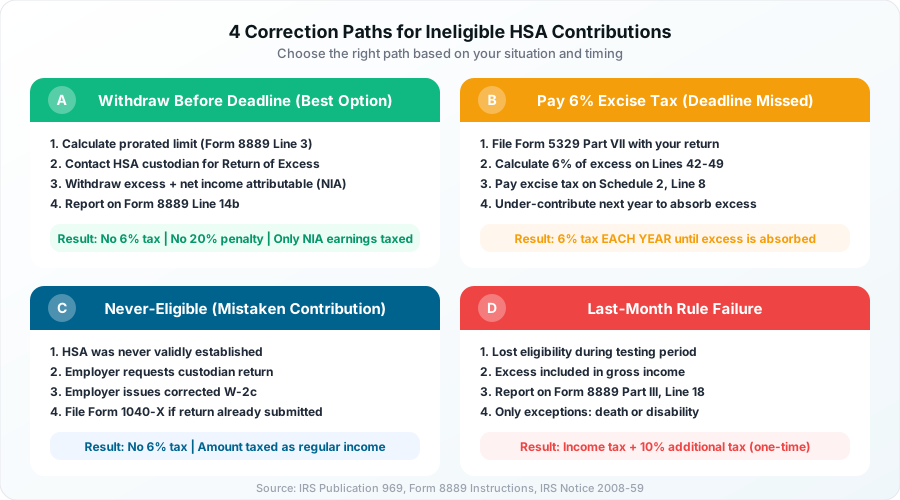
Path B: Pay the 6% Excise Tax (Deadline Missed)
If you missed the withdrawal deadline, you must file Form 5329, Part VII with your tax return.
Line 43: Prior year excess contributions (from your previous year's Form 5329, Line 49, if any)
Line 44: Amount of prior excess withdrawn in the current year or absorbed by under-contributing
Line 47: Current year excess contributions
Line 48: Total excess subject to the 6% tax
Line 49: Multiply Line 48 by 0.06 - this is your excise tax, reported on Schedule 2 (Form 1040), Line 8
The 6% tax recurs every year the excess remains. You can reduce the excess in future years by contributing less than the annual limit. The "room" between your contribution and the limit absorbs prior-year excess. For example, if you have $1,000 in excess from 2025 and contribute only $3,400 in 2026 (under the $4,400 self-only limit), the $1,000 gap absorbs the prior excess, ending the recurring penalty.
For a deeper walkthrough of Form 5329 mechanics, see our guide on Form 5329 and the 6% Excise Tax.
Path C: Never-Eligible Contributions (Mistaken Contribution)
This path applies when you were never eligible in the first place - for example, your plan was labeled HDHP but did not meet the IRS deductible minimums, or you never had HDHP coverage at all.
When you were never eligible, the HSA was never validly established under IRS Notice 2008-59. This means:
- The contributions were never "HSA contributions" under the law
- The 6% excise tax does not apply (there is no valid HSA)
- Employer contributions must be included in gross income
- The employer issues a corrected W-2c
- If you already filed, submit Form 1040-X to amend your return
This scenario is actually simpler than it sounds. The money goes back to being regular taxable income. No excise tax, no penalty - just the normal income tax you would have owed had the contribution never happened.
Path D: Last-Month Rule Testing Period Failure
If you used the last-month rule to contribute the full annual amount and then lost eligibility during the testing period, a different penalty applies. The excess is:
- Included in your gross income for the year you lost eligibility
- Subject to a 10% additional tax (not the 6% excise tax)
- Reported on Form 8889, Part III, Line 18
Example: Priya became eligible for family HDHP coverage on December 1, 2025. She contributed the full $8,550 under the last-month rule. In June 2026, she switched to a PPO. Her prorated limit without the last-month rule was $8,550 x 1/12 = $712.50. The excess is $7,837.50.
At a 22% tax bracket, she owes $1,724.25 in income tax on the excess plus $783.75 in the 10% additional tax - a total cost of $2,508 on the excess alone. The only exceptions to this penalty are death or disability.
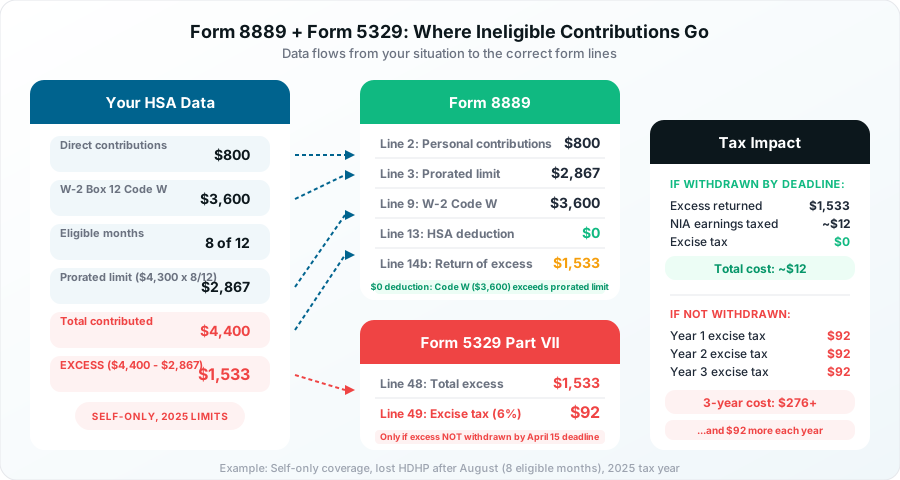
How to Report an Ineligible HSA Contribution on Form 8889 and Form 5329
Every person who had any HSA activity during the tax year must file Form 8889, even if the entire contribution was ineligible. Here is how the forms connect.
Form 8889 Reporting
Part I - Contributions and Deduction:
- Line 2: Enter only the contributions you made directly (not through payroll)
- Line 3: Use the Limitation Chart to calculate your prorated eligible contribution limit
- Line 6: Your deduction limit (the lesser of your contributions or the Line 3 limit)
- Line 9: Employer contributions from W-2 Box 12 Code W
- Line 13: Your HSA deduction (may be $0 if all contributions were through payroll or you were ineligible)
Part II - Distributions:
- Line 14a: Total distributions from Form 1099-SA
- Line 14b: Distributions included in Line 14a that were returns of excess contributions
- Line 15: Qualified medical expenses paid with HSA distributions
Part III - Income and Additional Tax (for testing period failures):
- Line 17b: Income from failure to maintain HDHP coverage
- Line 18: Additional 10% tax
If you need help understanding how Form 8889 connects to your other tax forms, see our step-by-step Form 8889 guide.
Form 5329 Reporting (Part VII)
Only file this if you have excess contributions remaining in your HSA at year-end that were not withdrawn by the deadline:
- Line 43: Excess from prior years (if any)
- Line 44: Amount of prior excess corrected this year
- Line 47: New excess contributions this year
- Line 48: Total excess subject to tax
- Line 49: 6% of Line 48 = your excise tax
Mistaken HSA Contribution vs. Excess Contribution: Key Differences
The IRS treats these as two different problems, and confusing them leads to the wrong fix.
| Factor | Excess Contribution | Mistaken Contribution |
|---|---|---|
| Who was eligible? | You were eligible but contributed too much | You were never eligible at all |
| Is the HSA valid? | Yes - the HSA is validly established | No - the HSA was never valid |
| 6% excise tax? | Yes, if not corrected by deadline | No - different correction rules apply |
| Correction method | Return of excess via HSA custodian | Employer issues W-2c; amount treated as wages |
| Tax treatment | Excess not deductible; earnings taxable on withdrawal | Full amount included in gross income |
| IRS authority | IRC Section 4973; Form 5329 | IRS Notice 2008-59 |
If your employer made the mistake, they have specific responsibilities. Per Newfront's analysis, the employer must request the custodian return the mistaken contribution, issue a corrected W-2c, and ensure the employee is not penalized for the employer's error. If your employer is dragging their feet on this, show them IRS Notice 2008-59 - it explicitly outlines the correction process.
Can You Still Use Your HSA After Losing HDHP Eligibility?
Yes. Losing HSA eligibility means you can no longer contribute, but you can still use existing funds for qualified medical expenses tax-free. Your HSA does not close or expire when you become ineligible. The money stays in your account and continues to grow tax-free.
You can use your HSA for:
- Qualified medical expenses at any time, tax-free and penalty-free
- Non-qualified expenses after age 65 (taxed as income, no 20% penalty)
- Non-qualified expenses before age 65 (taxed as income plus 20% penalty)
Use the HSA Orbit Expense Checker to verify whether a specific expense qualifies before you pay.
Pro Tip
Smart strategy: Even after losing eligibility, keep your HSA open. If you become eligible again in the future, you can resume contributing. The account's investment growth remains tax-free regardless of your current eligibility status.
The HSA Eligibility Checklist: How to Prevent This Mistake
Before making or continuing HSA contributions, verify all five of these items. One "no" means you cannot contribute for that month.
-
HDHP coverage confirmed: Your plan meets the IRS deductible minimum ($1,700 self-only / $3,400 family for 2026) and out-of-pocket maximum ($8,500 self-only / $17,000 family for 2026). Ask your benefits department to confirm - do not rely on the plan name alone.
-
No Medicare enrollment: You are not enrolled in Medicare Part A or Part B. If you are approaching 65, plan your application timing carefully to avoid the six-month retroactive trap.
-
No disqualifying FSA or HRA: Neither you nor your spouse has a general-purpose Health FSA or HRA. Limited-purpose (dental/vision only) and post-deductible arrangements are fine.
-
Not claimed as a dependent: No one claims you as a dependent on their tax return.
-
No other disqualifying coverage: You do not have VA benefits (used in the prior 3 months), Tricare, or coverage under a spouse's non-HDHP plan.
Run this checklist at open enrollment, after any job change, and after any life event that affects your health coverage. Use the HSA Orbit Eligibility Checker to verify your status in under 60 seconds.
Step-by-Step: Requesting a Return of Excess HSA Contributions
Here is the exact process to follow with your HSA custodian.
Step 1: Log into your HSA account and locate the excess contribution removal form. Most providers (Fidelity, HSA Bank, Optum, Lively) have this under "Forms" or "Distributions." Look for language like "Return of Excess Contribution" or "Excess Contribution Removal."
Step 2: Specify the tax year the excess applies to (e.g., 2025), the excess dollar amount, and whether the distribution should go via check or electronic transfer.
Step 3: The custodian calculates the net income attributable (NIA) to the excess. If the excess was invested and grew, the NIA can be significant. If the excess was in cash earning minimal interest, the NIA may be just a few cents.
Step 4: Receive the distribution. The custodian reports it on Form 1099-SA with distribution code 2 (excess contribution). This distinguishes it from a normal distribution (code 1).
Step 5: Report on your tax return. The excess itself is not taxable (it was never deducted). The NIA earnings are taxable as other income. No 20% penalty applies. No 6% excise tax applies.
Timing matters: If you need the withdrawal processed before April 15, start the request by late March. Some custodians take 5-10 business days to process excess contribution removals. Do not wait until April 14.
For related guidance on how to find your total HSA contributions across W-2s and direct deposits, see our reconciliation guide.