Filing your taxes with a Health Savings Account means you will encounter Form 8889 - the IRS form that reports your HSA contributions and distributions. Whether you contributed through payroll deductions, made personal contributions, or withdrew money for medical expenses, Form 8889 is mandatory for every HSA owner. Most tax guides skim over the details, but this form contains three distinct parts that work together to calculate your HSA deduction, report distributions, and determine any additional taxes owed. Understanding each line, especially the often-overlooked Part III, ensures you claim every dollar you are entitled to while staying fully compliant.
2025 Tax Year HSA Numbers
- Self-only coverage limit: $4,300; Family coverage limit: $8,550
- Catch-up contribution (age 55+): additional $1,000
- Excess contribution penalty: 6% excise tax per year (Form 5329)
- Non-qualified distribution penalty (under 65): 20% additional tax
- Filing deadline: April 15, 2026 for 2025 tax year contributions and filing
What Is Form 8889 and Who Must File It
Form 8889, Health Savings Accounts (HSAs), is the IRS form used to report HSA contributions (including employer contributions), figure your HSA deduction, report distributions from HSAs, and calculate amounts you must include in income and additional tax you may owe if you fail to be an eligible individual. The form is filed as an attachment to your Form 1040, 1040-SR, or 1040-NR.
According to the IRS Form 8889 Instructions, you must file Form 8889 if any of the following applies: you, your employer, or someone else made contributions to your HSA; your HSA made a distribution; you failed to be an "eligible individual" during a "testing period" and must recognize income; or you acquired an interest in an HSA because of the death of the account beneficiary.
Important
If you (or your spouse, if filing jointly) received HSA distributions in 2025, you must file Form 8889 with your federal return even if you have no taxable income or any other reason for filing. This catches many filers off guard - the form is required for any HSA activity, not just contributions.
The form consists of three parts: Part I (HSA Contributions and Deduction), Part II (HSA Distributions), and Part III (Income and Additional Tax for Failure To Maintain HDHP Coverage). Most filers only need Parts I and II.
Documents You Need Before You Start
Before you begin filling out Form 8889, gather these essential tax documents. Having everything on hand prevents errors and makes the process significantly faster.
Form W-2 from Your Employer
Box 12 with code "W" shows your employer and payroll HSA contributions. These pre-tax contributions are already excluded from your gross income on the W-2, so they do not appear in your Box 1 wages. This number goes on Form 8889, Line 9.
Form 1099-SA from Your HSA Custodian
Reports total distributions from your HSA during 2025. Your HSA custodian mails this by January 31 if you had any distributions. Box 1 shows the total amount distributed, which you enter on Form 8889, Line 14a.
Form 5498-SA (Informational)
Reports total contributions to your HSA and the fair market value at year-end. This form arrives by May 31 because you can still make prior-year contributions until the April 15 filing deadline. You do not need this form to file, but use it to verify your numbers.
Receipts and Records
Keep records of all direct contributions (not through payroll) and all distributions for qualified medical expenses. While the IRS does not require receipts with your return, you must produce documentation if audited. Store receipts for at least three years after filing.
Pro Tip
Form 5498-SA typically arrives after the filing deadline. You do not need to wait for it to file your return. Use your HSA account statements and W-2 Box 12 Code W to fill out Form 8889. The 5498-SA is a verification tool, not a required filing document.
Part I: HSA Contributions - Line-by-Line Walkthrough
Part I calculates your allowable HSA deduction based on your coverage type, contribution amounts, and eligibility months. This section walks through each line with a real example.
Example scenario: Sarah, age 40, had self-only HDHP coverage for all 12 months of 2025. She contributed $2,000 through payroll deductions (shown on her W-2 Box 12, Code W as $2,800, which includes $800 from her employer). She also made a $1,500 personal contribution directly to her HSA in March 2025.
Line 1: Coverage Type
Check the box to indicate your coverage under a high-deductible health plan (HDHP) during 2025. Per IRS Publication 969, an HDHP for 2025 must have a minimum deductible of $1,650 (self-only) or $3,300 (family) and a maximum out-of-pocket of $8,300 (self-only) or $16,600 (family).
If you had both self-only and family coverage at different times, check the box for the plan in effect longer. If you had both simultaneously, you are treated as having family coverage for that period. If on December 1 you had family coverage, check "family."
Sarah's entry: Checks "Self-only"
Line 2: HSA Contributions You Made
This is where many filers make their first mistake. Line 2 asks for contributions you made directly - meaning contributions from your bank account, not payroll deductions or employer contributions. Those go on Line 9.
Include on Line 2 only amounts you contributed outside of payroll. Do not include amounts from your W-2 Box 12 Code W here.
Sarah's entry: $1,500 (her direct contribution only)
Important
The most common Form 8889 mistake is putting your W-2 Box 12 Code W amount on Line 2. That amount goes on Line 9. Entering it on both lines double-counts your contributions and may trigger an excess contribution penalty. Line 2 is only for direct, out-of-pocket contributions you made to your HSA.
Lines 3-8: Contribution Limit Calculation
Line 3 calculates your HSA contribution limit. If you had self-only coverage for the full year, enter $4,300. If family coverage, enter $8,550. If your coverage changed mid-year, use the Line 3 Limitation Chart in the IRS instructions to prorate.
Sarah's calculation:
- Line 3: $4,300 (self-only, 12 months eligible)
- Line 4: -0- (no Archer MSA contributions)
- Line 5: $4,300
- Line 6: $4,300 (no spousal allocation needed - single filer)
- Line 7: -0- (under age 55, no catch-up)
- Line 8: $4,300 (her total contribution limit)
Good to Know
If you are age 55 or older at the end of 2025, you can make an additional $1,000 catch-up contribution. This increases your limit to $5,300 for self-only or $9,550 for family coverage. Use our contribution calculator to determine your exact limit.
Lines 9-13: Deduction Calculation
Line 9 is the critical line that captures employer and payroll contributions. Enter the amount from your W-2, Box 12, Code W. This includes both your pre-tax payroll deductions and any employer match or seed contributions.
Sarah's calculation:
- Line 9: $2,800 (from W-2 Box 12 Code W - includes $2,000 payroll + $800 employer)
- Line 10: -0- (no qualified HSA funding distribution from IRA)
- Line 11: $2,800
- Line 12: $4,300 - $2,800 = $1,500 (remaining deduction capacity)
- Line 13: $1,500 (her HSA deduction - the smaller of Line 2 or Line 12)
Line 13 is your HSA deduction. It goes on Schedule 1 (Form 1040), Line 13. This is an "above-the-line" deduction, meaning you get it whether you itemize or take the standard deduction.
Sarah's total HSA benefit: $2,800 was excluded from income via payroll (already reflected in her W-2 Box 1 wages), plus she deducts $1,500 on her return. Her full $4,300 in contributions reduces her taxable income.
Important
If Line 2 exceeds Line 12, you have excess contributions. You must withdraw the excess (plus any earnings) by your tax filing deadline to avoid a 6% excise tax that applies every year the excess remains in your account.
Married Couples Filing Jointly
If both spouses have HSAs, each must complete a separate Form 8889. Combine the Line 13 amounts from both forms and enter the total on Schedule 1, Line 13. If either spouse has family HDHP coverage, both are treated as having family coverage. You can split the family contribution limit ($8,550) in any proportion you both agree to. Learn more about the triple tax advantage of maxing out your HSA contributions.
Part II: HSA Distributions - Reporting What You Took Out
Part II reports all money that came out of your HSA during 2025 and determines whether any portion is taxable. This is where careful record-keeping matters most - the IRS relies on you to self-report which distributions were for qualified medical expenses.
Example continued: Sarah took $1,800 in distributions during 2025: $1,200 for prescription medications, $400 for dental work, and $200 for a gym membership (not a qualified expense).
Line 14a: Total Distributions
Enter the total distributions from Form 1099-SA, Box 1. This includes every dollar that left your HSA, whether used for medical expenses, transferred to another HSA, or used for non-qualified purposes.
Sarah's entry: $1,800 (from Form 1099-SA, Box 1)
Line 14b: Rollovers and Returns of Excess
Enter any amounts that were rollovers to another HSA (completed within 60 days) or returns of excess contributions withdrawn before your filing deadline.
Sarah's entry: -0-
Line 14c: Net Distributions
Subtract Line 14b from Line 14a.
Sarah's entry: $1,800 - $0 = $1,800
Line 15: Qualified Medical Expenses
This is the line where your receipts matter. Enter only distributions used for qualified medical expenses not reimbursed by insurance. The IRS does not automatically know whether your distributions were qualified - you determine this amount based on your records.
Sarah's qualified expenses: $1,200 (prescriptions) + $400 (dental) = $1,600 The $200 gym membership is not a qualified medical expense per IRS Publication 502.
Sarah's entry on Line 15: $1,600
Use our expense checker to verify whether a specific expense qualifies before using your HSA funds.
Line 16: Taxable HSA Distributions
Subtract Line 15 from Line 14c. This amount is taxable income reported on Schedule 1, Line 8f.
Sarah's calculation: $1,800 - $1,600 = $200 (taxable)
Lines 17a-17b: Additional 20% Tax
If you are under 65, not disabled, and took non-qualified distributions, you owe a 20% penalty on the taxable amount.
Sarah's calculation: $200 x 0.20 = $40 (reported on Schedule 2, Line 17c)
Important
Sarah's $200 gym membership distribution costs her $40 in penalty plus approximately $44 in income tax (at 22% bracket) - a total of $84 in taxes on a $200 expense. That is a 42% effective tax rate. Always verify an expense qualifies before using your HSA card.
Part III: The Last-Month Rule and Testing Period
Most filers can skip Part III entirely. You only complete this section if you used the last-month rule to make a full-year contribution but did not remain HDHP-eligible for the entire testing period, or if you made a qualified HSA funding distribution from an IRA.
Understanding the Last-Month Rule
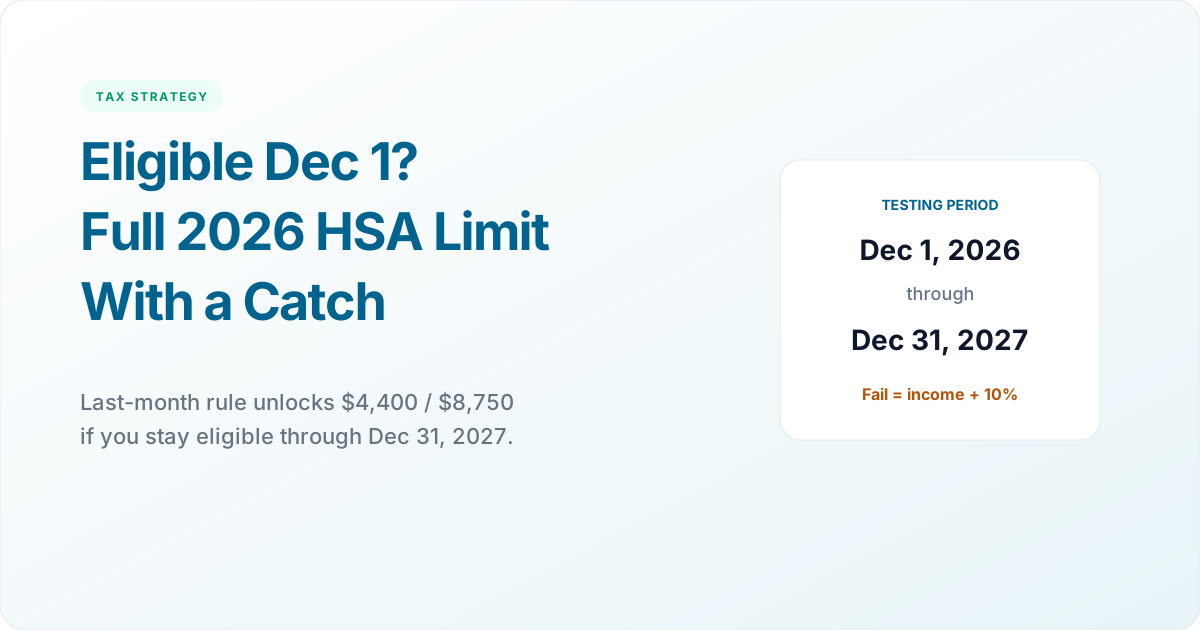
The last-month rule allows you to contribute the full annual limit if you are eligible on December 1, even if you were not eligible for all 12 months. However, you must remain eligible through December 31 of the following year (the "testing period"). Failure triggers income inclusion and a 10% additional tax.
Example: David, age 50, became HSA-eligible on December 1, 2025 (self-only coverage). Using the last-month rule, he contributed the full $4,300. In June 2026, he switched to a non-HDHP plan, failing the testing period.
David's 2026 Form 8889, Part III:
- Line 18: $4,300 - $358 (1/12 prorated) = $3,942 (excess from last-month rule)
- Line 20: $3,942 (included in income on Schedule 1, Line 8f)
- Line 21: $3,942 x 0.10 = $394 (10% additional tax on Schedule 2)
Important
Testing period failures are expensive. David owes income tax on $3,942 plus a $394 penalty. Only use the last-month rule if you are confident you will maintain HDHP coverage through the end of the following year.
How Form 8889 Connects to Your Tax Return
Understanding how Form 8889 flows into your main return helps you see the complete picture and verify your numbers.
Schedule 1 (Form 1040) connections:
- Line 13 (Adjustments to Income): Your HSA deduction from Form 8889, Line 13. This is an above-the-line deduction - you get it even with the standard deduction.
- Line 8f (Additional Income): Taxable distributions from Form 8889, Line 16 and Part III income from Line 20.
Schedule 2 (Form 1040) connections:
- Line 17c: The 20% penalty on non-qualified distributions (Form 8889, Line 17b)
- Line 17d: The 10% penalty for testing period failures (Form 8889, Line 21)
Form 5329: If you have excess contributions that were not withdrawn by the filing deadline, file Form 5329, Part VII to calculate the 6% excise tax. This tax applies every year until the excess is corrected.
Good to Know
A typical HSA owner filing 2025 taxes will submit: Form 1040, Schedule 1 (with HSA deduction), and Form 8889. You may also need Schedule 2 (if penalties apply) and Form 5329 (if excess contributions remain). All major tax software handles these forms automatically.
Common Filing Scenarios With Worked Examples
Scenario 1: Mid-Year Job Change With Two Employers
Facts: Jason had family HDHP coverage all year. Employer A contributed $2,000 (January through June). Employer B contributed $2,500 (July through December). Jason contributed $1,000 directly. He is 48 years old.
- Line 1: Family
- Line 2: $1,000 (direct contribution only)
- Line 8: $8,550 (family limit, full year)
- Line 9: $4,500 (total from both W-2s, Box 12 Code W)
- Line 12: $8,550 - $4,500 = $4,050
- Line 13: $1,000 (smaller of Line 2 or Line 12)
Result: Jason deducts $1,000 on Schedule 1. His total HSA benefit is $5,500 ($4,500 excluded via payroll + $1,000 deduction). No excess contributions.
Scenario 2: Over-Contribution Corrected Before Filing
Facts: Maria, 30, self-only coverage, contributed $5,000 total but the limit was $4,300. On March 1, 2026, she withdrew the $700 excess plus $15 in earnings before filing her return on April 10.
- Line 2: $5,000 (total contributions made)
- Line 13: $4,300 (full deduction allowed after correction)
- Line 14a: $715 (excess + earnings withdrawn, shown on 1099-SA)
- Line 14b: $715 (returned excess contributions)
Result: No 6% penalty because she corrected before filing. The $15 in earnings is taxable income but no 20% penalty applies to properly withdrawn excess contributions.
Scenario 3: Medicare Enrollment Mid-Year
Facts: Patricia turned 65 in July 2025 and enrolled in Medicare effective August 1. She had self-only HDHP coverage through July and contributed $4,300 in January.
Her prorated limit: 7 eligible months / 12 x ($4,300 + $1,000 catch-up) = $3,092 Excess: $4,300 - $3,092 = $1,208
Result: Patricia must withdraw the $1,208 excess by April 15, 2026 or pay 6% excise tax ($72) annually until corrected. You cannot contribute for any month you are enrolled in Medicare.
Pro Tip
If you over-contributed and already filed your return, you can still withdraw the excess by filing an amended return no later than 6 months after your original due date. Write "Filed pursuant to section 301.9100-2" at the top of the amended return.
For more HSA tax strategies to maximize your savings, including the receipt-hoarding strategy and retirement bridge planning, see our complete guide.
Frequently Asked Questions
Next Steps: Action Checklist
Written by
Michael is a Certified Public Accountant and IRS Enrolled Agent who has spent 12 years helping individuals and businesses navigate tax-advantaged health accounts. He leads HSA Orbit's tax strategy content.