When the temporary COVID-era relief for HSA-eligible telehealth ended on December 31, 2024, high-deductible health plan (HDHP) holders faced a question: would their $0 virtual visits suddenly disqualify them from Health Savings Account contributions? On July 4, 2025, the One Big Beautiful Bill Act (OBBBA) answered: the telehealth safe harbor is now permanent for plan years beginning after December 31, 2024. But as X user @morisgrant1 pointed out in September 2026, "HSA and telehealth existed before 2024. What did you guys add?" The answer is that Congress finally made permanent what had been a patchwork of temporary extensions—and the IRS spelled out exactly what "telehealth" means in Notice 2026-5.
This article explains which telehealth services keep your HDHP HSA-eligible under the permanent safe harbor, what the 2027 contribution limits are, and what to check during 2027 open enrollment. It's not a comprehensive guide to HSA contribution limits for 2027 (covered separately) or whether your HDHP or PPO is cheaper overall.
Telehealth Safe Harbor: Three-Line Answer
- Permanent: For plan years beginning after December 31, 2024, an HDHP may cover telehealth services with no deductible. The plan won't fail to be an HDHP solely because of this (IRC §223(c)(2)(E)).
- What counts: Services on HHS's annual Medicare telehealth list published under Social Security Act §1834(m)(4)(F), or services meeting the principles of SSA §1834(m) and 42 CFR 410.78 (Notice 2026-5 Q&A-2).
- What doesn't count: In-person services, medical equipment, or drugs furnished in connection with telehealth visits, unless they qualify as telehealth services themselves (Notice 2026-5 Q&A-3).
What Changed: From Temporary Relief to Permanent Law
The CARES Act (March 2020) created a temporary safe harbor allowing HDHPs to cover telehealth before the deductible (Pub. L. 116-136, §3701(a)). Congress extended it through 2024. Plan years beginning in 2025 lost the safe harbor until OBBBA §71306 permanently amended IRC §223(c)(2)(E) on July 4, 2025, effective retroactively for plan years beginning after December 31, 2024 (Notice 2026-5 Background II.B.1). The IRS released Notice 2026-5 on December 9, 2025, defining which services qualify.
The 2025 Retroactive Fix
If you had pre-deductible telehealth in early 2025 before OBBBA passed, you were still HSA-eligible. Notice 2026-5 Q&A-1: "Yes, an otherwise eligible individual may contribute to an HSA for 2025 if, before the OBBBA was enacted on July 4, 2025, the individual was enrolled in a health plan that provided coverage for telehealth or other remote care services before the minimum deductible was satisfied, if the health plan otherwise satisfied the requirements to be treated as an HDHP." This applies to all 2025 contributions made before or after July 4, 2025.
What Counts as "Telehealth" Under Notice 2026-5
The permanent safe harbor in IRC §223(c)(2)(E) uses the phrase "telehealth and other remote care services," but the statute does not define it. Notice 2026-5 Q&A-2 fills the gap:
"A plan will not fail to be an HDHP solely because it offers telehealth benefits without a deductible for a service that is included on the list of telehealth services payable by Medicare that is published annually by the Department of Health and Human Services (HHS) under section 1834(m)(4)(F) of the SSA. For services that are not included on the HHS list, taxpayers should apply the principles of section 1834(m) of the SSA, its implementing regulations at 42 CFR 410.78, and other guidance issued by HHS defining 'telehealth services' and related terms."
The Medicare Telehealth List
HHS publishes an annual list of Medicare telehealth services under SSA §1834(m)(4)(F). For 2026, CMS maintains the list at https://www.cms.gov/medicare/coverage/telehealth/list-services. The page shows the CY 2026 list as of the most recent update. The CY 2027 list will be published with the Calendar Year 2027 Physician Fee Schedule final rule.
The IRS points to this list as the primary safe harbor. If your HDHP's pre-deductible telehealth benefit covers a service on this list, it qualifies.
We do not list specific services or HCPCS codes here because the list changes annually. Check the CMS page directly or ask your plan administrator whether a specific service (for example, a virtual office visit or psychotherapy session) is on the current year's Medicare telehealth list.
The Regulatory Principles Fallback
For services not on the HHS list, the IRS says to apply the "principles" of SSA §1834(m), 42 CFR 410.78, and related HHS guidance. The Medicare regulations define an interactive telecommunications system as multimedia equipment that includes, at a minimum, audio and video permitting two-way, real-time interactive communication between the patient and the distant-site provider (42 CFR 410.78(a)(3)).
Audio-only telehealth: 42 CFR 410.78(a)(3) allows audio-only when the provider is technically capable of video but the patient cannot or does not consent. Whether audio-only employer telehealth qualifies under Notice 2026-5's "principles" language is not explicitly addressed—check with your plan administrator.
Asynchronous store-and-forward: 42 CFR 410.78(a)(1) excludes "telephone calls, images transmitted via facsimile machines and text messages without visualization of the patient (electronic mail)." Plain text portal messages or phone calls are unlikely to qualify.
What Doesn't Count: The Q&A-3 Exclusions
Notice 2026-5 Q&A-3 asks: "Do telehealth or other remote care services extend to in-person services, medical equipment, or drugs furnished in connection with those services?"
Answer: No. "Telehealth or other remote care services do not extend to in-person services, medical equipment, or drugs furnished in connection with those services unless they would otherwise be treated as telehealth services under guidance provided in Q&A-2."
Practical Examples
Scenario 1: Virtual visit + lab order You have a $0 telehealth visit (on the Medicare list). The doctor orders blood work. The lab visit is an in-person service—Q&A-3 says it does not fall under the telehealth safe harbor. If your HDHP waives the deductible for the lab, that could disqualify the plan unless the lab benefit fits another safe harbor (for example, preventive care under IRC §223(c)(2)(C)).
Scenario 2: GLP-1 prescription via telehealth You use a telehealth platform to get a prescription for Wegovy or Zepbound. The telehealth visit itself may qualify if it is on the Medicare list. The prescription drug does not (Q&A-3). If your HDHP's pharmacy benefit covers GLP-1s before the deductible, that pre-deductible coverage is not protected by the telehealth safe harbor. (For whether you can pay for GLP-1s from your HSA, that is a separate qualified-expense question.)
Scenario 3: Equipment or in-person follow-up Medical equipment (scales, monitors) shipped with telehealth enrollment does not qualify under Q&A-3. Similarly, mandatory in-person follow-ups covered before the deductible are not protected by the safe harbor.
Important
The safe harbor is service-specific. Just because your plan labels something "part of our telehealth program" does not mean every component is protected. Ask your benefits administrator which services are on the Medicare telehealth list and whether any bundled equipment, labs, or prescriptions are separately subject to the deductible.
Standalone Employer Telehealth Benefits
Many employers offer telehealth access outside the HDHP—a separate employer benefit with its own app and provider network. Is that disqualifying other coverage under IRC §223(c)(1)(A)(ii)?
Pre-OBBBA, it usually was. Separate telehealth coverage that paid for medical services before your HDHP's deductible was typically disqualifying.
Post-OBBBA: IRC §223(c)(1)(B)(ii) now says the eligible-individual test "shall be applied without regard to" coverage "for accidents, disability, dental care, vision care, long-term care, or telehealth and other remote care." This suggests standalone telehealth is disregarded coverage. However, Notice 2026-5 does not include a Q&A explicitly confirming this. Ask your plan administrator whether the benefit is structured as disregarded telehealth coverage under the statute.
The Safe Harbor Is Optional—Your Plan Decides Whether to Charge You
IRC §223(c)(2)(E) says a plan "shall not fail to be treated as a high deductible health plan by reason of failing to have a deductible" for telehealth services. This is a permissive safe harbor—the IRS allows HDHPs to waive the deductible for telehealth without losing HDHP status. It does not require every HDHP to waive the deductible.
Real 2027 example: Penn State's 2027 Open Enrollment slides show the Lion Advantage HSA plan (an HDHP) offers Well360 Virtual Care with a "$0 cost share for applicable Penn State plan members," but Technical Services employees "enrolled in Lion Advantage HSA will pay $64.00 per visit until deductible is met; $0 cost share after deductible" (source PDF, slide 18). The same HDHP, different member groups, different telehealth cost sharing.
Check your Summary of Benefits and Coverage to see whether telehealth is $0 or subject to the deductible, and verify the plan document doesn't contain outdated language stating that telehealth relief ends December 31, 2024. Plans that charge for virtual visits until you meet the deductible are still HDHPs—the safe harbor is optional.
2027 Contribution Limits and HDHP Thresholds
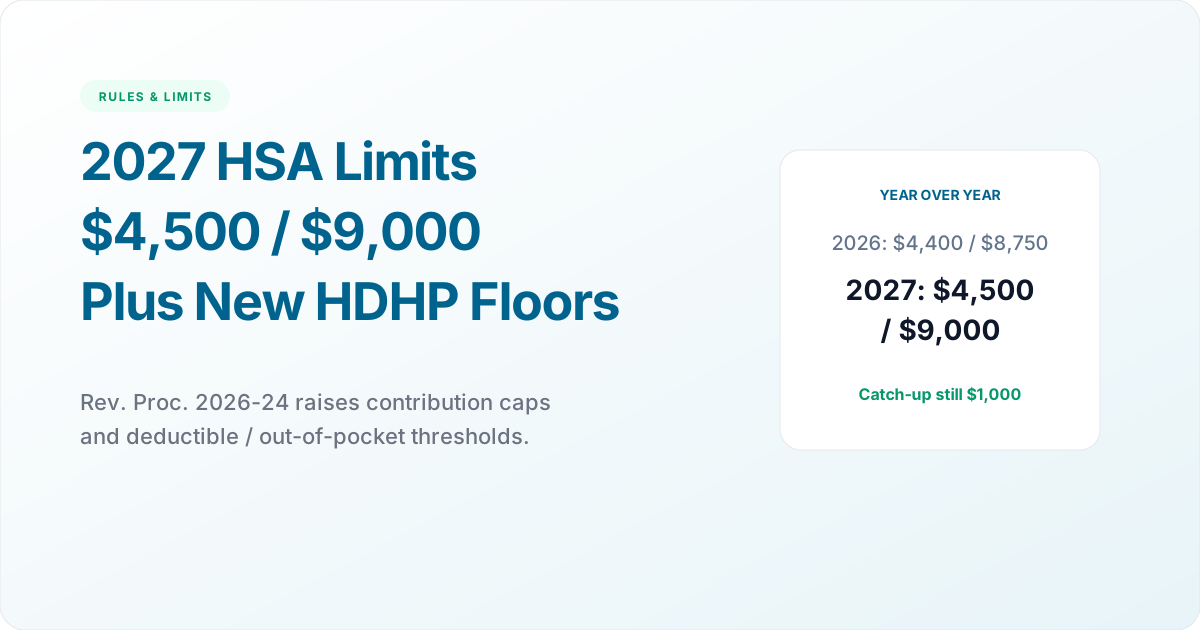
For calendar year 2027, the IRS set the following figures in Revenue Procedure 2026-24:
| Item | Self-Only | Family |
|---|---|---|
| Annual HSA contribution limit | $4,500 | $9,000 |
| Age 55+ catch-up contribution | +$1,000 | +$1,000 (per eligible spouse in their own HSA) |
| HDHP minimum annual deductible | $1,750 | $3,500 |
| HDHP maximum out-of-pocket | $8,700 | $17,400 |
These figures increased from 2026 ($4,400/$8,750 contribution limits; $1,700/$3,400 deductibles; $8,500/$17,000 OOP maxes, per Notice 2026-5 footnote 1 citing Rev. Proc. 2025-19).
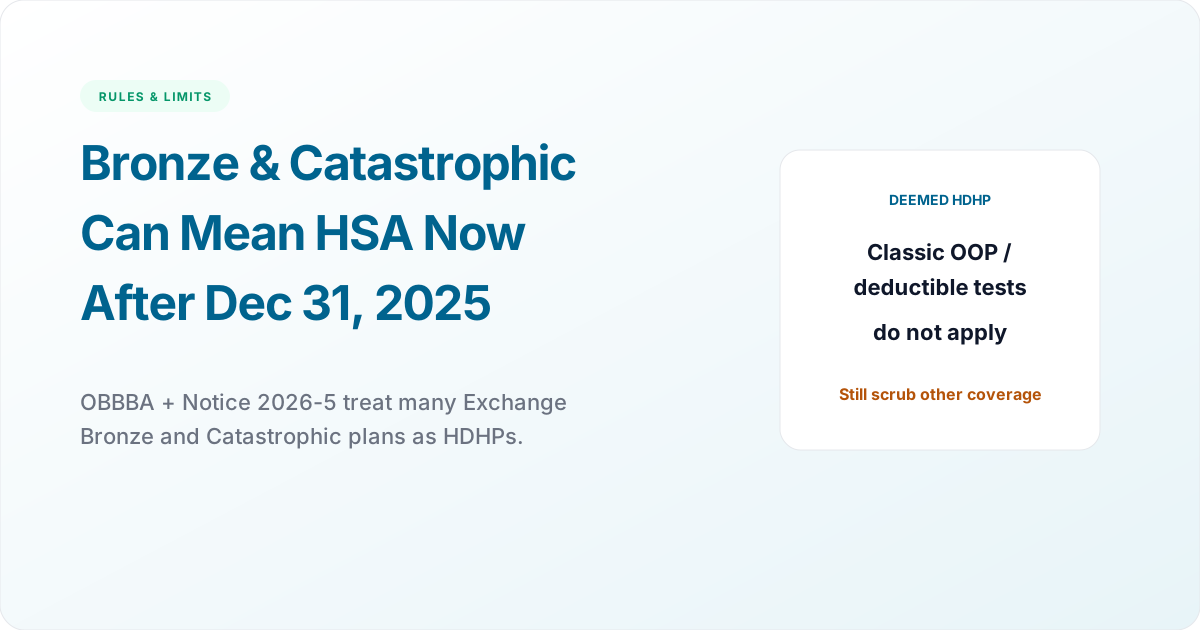
Bronze and Catastrophic plans: Qualifying plans under IRC §223(c)(2)(F) are deemed HDHPs regardless of these thresholds (see Bronze and Catastrophic HSA eligibility).
Open Enrollment Checklist: What to Ask Your Plan
Direct Primary Care and the Telehealth Safe Harbor
Notice 2026-5 Q&A-15 clarifies that an HDHP cannot use the telehealth safe harbor to pay DPC fees pre-deductible. DPC has its own statutory framework under IRC §223(c)(2)(D). The telehealth safe harbor in §223(c)(2)(E) is separate and does not expand what DPC can cover before the deductible.
Frequently Asked Questions
Related Articles
- HSA Contribution Limits for 2027 — Full 2027 limits, catch-up contributions, and HDHP thresholds
- HDHP vs PPO for 2027 Open Enrollment — Five-number test to pick the cheaper plan
- Bronze and Catastrophic Plans HSA Eligibility — OBBBA's deemed-HDHP rule for ACA plans
- Direct Primary Care and HSAs — How DPC works with HSAs after OBBBA
- Can You Use Your HSA for GLP-1s? — Wegovy, Zepbound, and qualified medical expenses
- Keep Your HSA Without an HDHP — What happens when you leave HDHP coverage
Sources
IRS Primary Sources:
- Internal Revenue Code §223(c)(2)(E) (telehealth safe harbor): https://www.law.cornell.edu/uscode/text/26/223
- IRS Notice 2026-5 (released Dec. 9, 2025): https://www.irs.gov/pub/irs-drop/n-26-05.pdf
- Revenue Procedure 2026-24 (2027 limits): https://www.irs.gov/pub/irs-drop/rp-26-24.pdf
- IRS Newsroom IR-2025-119 (Dec. 9, 2025): https://www.irs.gov/newsroom/treasury-irs-provide-guidance-on-new-tax-benefits-for-health-savings-account-participants-under-the-one-big-beautiful-bill
- Publication 969 (2025): https://www.irs.gov/pub/irs-pdf/p969.pdf
- Instructions for Form 8889 (2025): https://www.irs.gov/pub/irs-pdf/i8889.pdf
HHS / CMS Sources:
- 42 CFR 410.78 (Medicare telehealth regulations): https://www.ecfr.gov/current/title-42/chapter-IV/subchapter-B/part-410/subpart-B/section-410.78
- CMS List of Telehealth Services: https://www.cms.gov/medicare/coverage/telehealth/list-services
- HealthCare.gov HSA-eligible plans: https://www.healthcare.gov/high-deductible-health-plan/hdhp-hsa-information/
Provider and Employer Sources:
- Penn State 2027 Open Enrollment presentation: https://hr.psu.edu/sites/hr/files/2027openenrollmentpresentationslides.pdf
- HealthEquity blog (Nicky Brown, July 8, 2025): https://www.healthequity.com/blog/new-hsa-benefits-provisions-megabill
- HSA Bank Learning Center: https://www.hsabank.com/HSABank/Learning-Center/New-legislation-expands-benefit-accounts
Social Media References:
- X post by @morisgrant1 (Sept. 4, 2026): https://x.com/morisgrant1/status/2095979733670384108
Written by
Michael is a Certified Public Accountant and IRS Enrolled Agent who has spent 12 years helping individuals and businesses navigate tax-advantaged health accounts. He leads HSA Orbit's tax strategy content.