If you are 55 or older and enrolled in a High Deductible Health Plan, the IRS gives you access to a powerful and frequently overlooked tax break: the HSA catch-up contribution. This additional $1,000 per year on top of the standard contribution limit might sound modest at first glance, but the math tells a different story. Invested over the decade between age 55 and 65, that extra $1,000 annually can grow into nearly $15,000 in tax-free wealth, and if left untouched, over $40,000 by age 80. For anyone approaching retirement with grown children, lower household expenses, and a higher tax bracket, the HSA catch-up contribution is one of the most efficient moves in the entire tax code.
The HSA Catch-Up at a Glance
- Who qualifies: Anyone age 55 or older by December 31 of the tax year
- Extra amount: $1,000 per year on top of the standard HSA contribution limit
- 2026 maximum with catch-up: $5,400 (self-only) or $9,750 (family coverage)
- Tax benefit: Deductible from income, grows tax-free, and withdraws tax-free for medical expenses
- Married couples: Both spouses can each make a $1,000 catch-up if both are 55+, but each must use their own HSA
What Is an HSA Catch-Up Contribution?
A catch-up contribution is an additional amount the IRS allows older savers to contribute to certain tax-advantaged accounts beyond the standard annual limit. You are probably familiar with the concept from 401(k) plans, which permit an extra $7,500 per year for workers 50 and older. The HSA version works the same way, but the eligibility age is 55 rather than 50, and the extra amount is $1,000.
The logic behind catch-up contributions is straightforward: as you approach retirement, you have fewer years to save. The IRS recognizes this by letting you accelerate your contributions during the final stretch of your working years. For HSAs specifically, the catch-up provision has been part of the tax code since HSAs were created in 2004 under IRC Section 223(b)(3)(B).
Here is what makes the HSA catch-up uniquely valuable compared to other catch-up provisions: the HSA is the only account in the tax code with a triple tax advantage. Your catch-up contribution is tax-deductible going in, grows tax-free while invested, and comes out tax-free when used for qualified medical expenses. No 401(k) catch-up or IRA catch-up can match all three.
Good to Know
The $1,000 HSA catch-up amount has remained fixed since 2004. Unlike the base HSA contribution limits, which the IRS adjusts annually for inflation, the catch-up amount is set by statute and does not change. In 2004 dollars, $1,000 had the purchasing power of roughly $1,600 today, meaning the real value of the catch-up has eroded over time. That makes using it now even more important - every year you skip is a year of compounding you cannot recover.
HSA Catch-Up Contribution Limits for 2025 and 2026
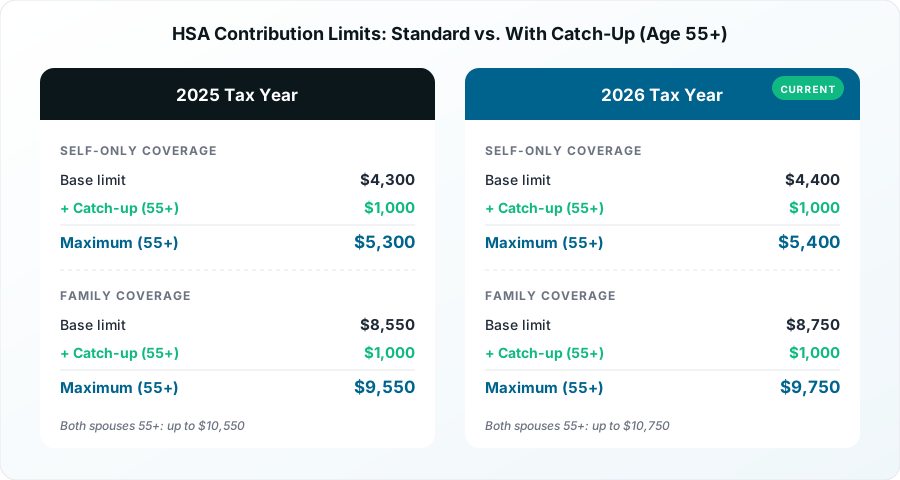
The catch-up contribution stacks on top of the standard HSA limit, which changes every year based on IRS inflation adjustments. Here are the current numbers:
| Category | 2025 | 2026 |
|---|---|---|
| Self-only base limit | $4,300 | $4,400 |
| Family base limit | $8,550 | $8,750 |
| Catch-up contribution (55+) | $1,000 | $1,000 |
| Self-only max with catch-up | $5,300 | $5,400 |
| Family max with catch-up | $9,550 | $9,750 |
These limits include all contributions from every source: your personal deposits, employer contributions, and any payroll deductions made on your behalf. If your employer contributes $1,500 to your HSA and you have self-only coverage in 2026, your personal contribution cap (including catch-up) is $5,400 minus $1,500, or $3,900.
For the full breakdown of base limits, HDHP requirements, and employer contribution rules, see our complete 2026 contribution limits guide.
Eligibility Rules: Who Qualifies for the HSA Catch-Up
To make an HSA catch-up contribution, you must meet two sets of requirements: the standard HSA eligibility rules and the age threshold.
Standard HSA Eligibility
You must be enrolled in a qualifying High Deductible Health Plan (HDHP). For 2026, that means your plan must have a minimum annual deductible of $1,650 (self-only) or $3,300 (family), and a maximum out-of-pocket limit of $8,300 (self-only) or $16,600 (family). You also cannot be enrolled in Medicare, cannot be claimed as a dependent on someone else's tax return, and cannot have disqualifying coverage such as a general-purpose FSA. Use our eligibility checker to verify your status.
The Age 55 Threshold
You qualify for the catch-up contribution in any tax year in which you turn 55 or older by December 31. This means if your 55th birthday is on December 31, 2026, you can make the full $1,000 catch-up contribution for the 2026 tax year. You do not need to have been 55 for the entire year.
Partial-Year Coverage and the Last-Month Rule
What if you only had HDHP coverage for part of the year? Normally, your contribution limit is prorated: divide the annual limit by 12 and multiply by the number of months you were eligible. However, the last-month rule provides an exception. If you are HSA-eligible on December 1 of the tax year, you can contribute the full annual amount, including the catch-up. The catch is that you must remain HSA-eligible for the following 12 months (the "testing period"). If you lose eligibility during that time, the excess contributions are included in your taxable income and subject to a 10% penalty.
Important
The last-month rule carries risk for those approaching 65. If you turn 65 in 2027 and plan to enroll in Medicare, using the last-month rule for your 2026 contribution could create a testing-period violation. Carefully calculate whether you will maintain HDHP eligibility through December 2027 before relying on this rule.
The Medicare Trap: Why Catch-Up Contributions End at 65
The single biggest risk for HSA catch-up contributors is the hard stop that occurs when you enroll in Medicare. Once you are covered by Medicare Part A or Part B, you are no longer eligible to contribute to an HSA - period. This includes catch-up contributions.
The 6-Month Retroactive Enrollment Problem
Here is where many people get caught. If you are receiving Social Security benefits, you are automatically enrolled in Medicare Part A when you turn 65. And if you delay enrolling in Medicare past your Initial Enrollment Period, Part A coverage can be applied retroactively up to six months from your enrollment date.
This means if you enroll in Medicare at age 65 and 6 months, your Part A coverage may be retroactively applied to your 65th birthday. Any HSA contributions you made during those six retroactive months become excess contributions, subject to the 6% excise tax on Form 5329.
How to Protect Yourself
If you plan to work past 65 and want to keep contributing to your HSA, do not apply for Social Security benefits. Social Security enrollment triggers automatic Medicare Part A enrollment, which retroactively disqualifies your HSA contributions. If you are already receiving Social Security, Medicare Part A enrollment is mandatory at 65. In that scenario, stop all HSA contributions at least six months before your 65th birthday to avoid the retroactive trap.
Pro Tip
Still working at 65 with employer coverage? If your employer has 20 or more employees, you may be able to delay Medicare enrollment without penalty while your employer group health plan is your primary coverage. This lets you continue HSA contributions past 65, but consult with your HR department and a tax professional to confirm your specific situation.
Spousal Catch-Up Contributions: Maximizing as a Couple
If you are married and both spouses are 55 or older, each spouse can make their own $1,000 catch-up contribution. This is where the household math gets compelling.
The Critical Rule: Separate HSAs Required
The catch-up contribution is a per-person benefit, and each spouse must deposit their catch-up into their own individual HSA. You cannot put both catch-up contributions into a single account. If only one spouse has an HSA, the other spouse needs to open a separate HSA to receive their catch-up contribution. This is true even if only one spouse is enrolled in the HDHP.
Household Maximum for 2026
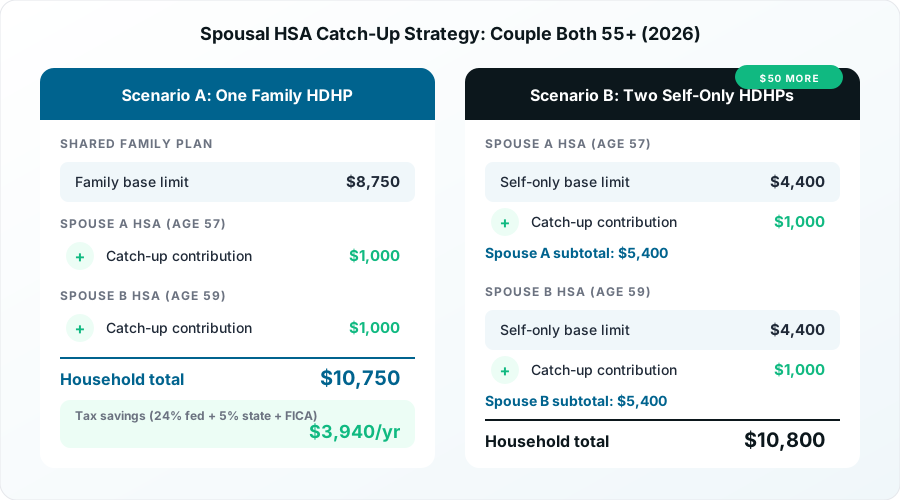
For a married couple both 55 or older with family HDHP coverage:
- Base family contribution limit: $8,750
- Spouse A catch-up contribution (in Spouse A's HSA): $1,000
- Spouse B catch-up contribution (in Spouse B's HSA): $1,000
- Total household contribution: $10,750
At a 24% federal tax bracket plus 5% state income tax, that $10,750 saves the household $2,580 in federal tax and $537 in state tax. If contributed through payroll deduction, add another $822 in FICA savings, bringing the total annual tax benefit to approximately $3,940.
For comparison, if both spouses each carry self-only HDHP coverage through separate employers, each can contribute $4,400 plus $1,000 catch-up to their own HSA, for a combined household total of $10,800 - actually $50 more than the family coverage route.
How to Make Your Catch-Up Contribution
There are two ways to get the extra $1,000 into your HSA, and one is meaningfully better than the other.
Option 1: Payroll Deduction (Recommended)
Contact your HR department or update your benefits elections to increase your per-paycheck HSA deduction by enough to include the additional $1,000 over the course of the year. For most people on 24 pay periods, that is roughly $42 more per paycheck.
Payroll deductions are the most tax-efficient method because they bypass FICA taxes (Social Security and Medicare taxes at 7.65%) in addition to federal and state income taxes. A $1,000 payroll HSA contribution saves you $76.50 in FICA taxes that a direct contribution cannot recover. Many employers allow mid-year changes to HSA contribution elections during open enrollment or qualifying life events.
Option 2: Direct Contribution
If your employer does not support payroll HSA deductions, or if you want to make a lump-sum contribution, you can contribute directly from your bank account to your HSA. You will claim the tax deduction on Form 8889 when you file your taxes. However, you will not recoup the 7.65% FICA taxes with this method.
Pro Tip
Open enrollment is the perfect time to act. If your employer just sent you an open enrollment notice mentioning catch-up contributions, do not let it pass. Log into your benefits portal and increase your HSA payroll deduction to include the additional $1,000. Most benefits systems have a specific field for catch-up contributions, or you can simply increase your total annual election by $1,000.
Timing Your Contribution
You can make contributions for the 2026 tax year anytime between January 1, 2026, and April 15, 2027. However, spreading contributions evenly through payroll deductions offers three advantages: dollar-cost averaging on investments, automatic FICA savings, and no risk of forgetting a lump-sum deposit. If you do make a direct contribution after year-end, make sure to designate it for the correct tax year with your HSA custodian.
Catch-Up Contributions as a Retirement Accelerator
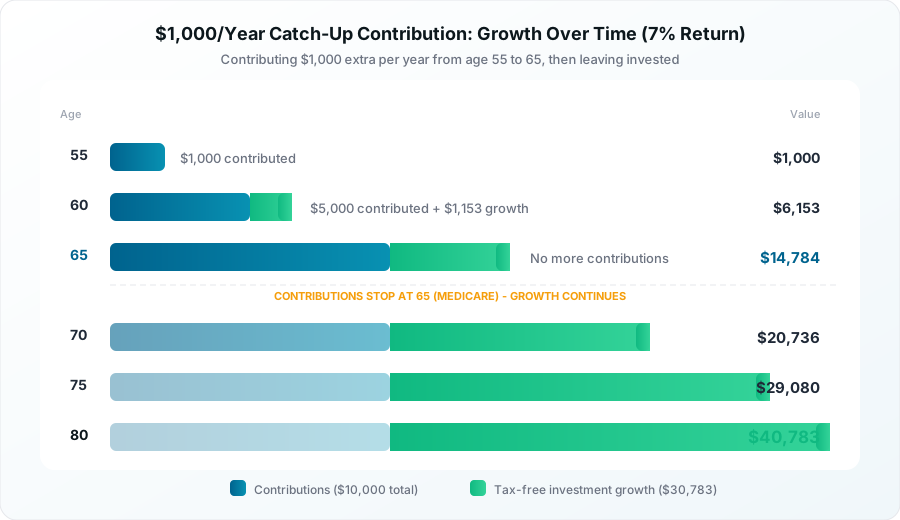
Here is the part most people miss entirely: the $1,000 catch-up contribution is not really about $1,000. It is about what $1,000 per year becomes when you invest it tax-free inside your HSA over the decade between 55 and 65, and then let it continue compounding through retirement.
The Compounding Math
Contributing an extra $1,000 per year from age 55 to 65, invested at a 7% average annual return:
- Total contributed: $10,000
- Balance at age 65: approximately $14,784
- Balance at age 70 (left invested, no withdrawals): approximately $20,736
- Balance at age 75: approximately $29,080
- Balance at age 80: approximately $40,783
That is $10,000 in catch-up contributions growing into over $40,000 in tax-free wealth by age 80. Layer in the annual tax deductions you received on those contributions (roughly $2,200 to $3,700 depending on your bracket), and the true value of the catch-up is closer to $44,000.
Why Your Good Health Is Your HSA's Best Friend
If you are healthy at 55, rarely visit the doctor, and do not take daily medications, you are in the ideal position to maximize HSA wealth. The counterintuitive strategy: do not use your HSA for the occasional doctor visit or prescription. Pay those small expenses out of pocket instead. Let every dollar in your HSA - including the catch-up contribution - stay invested and compound tax-free.
Save every medical receipt in a cloud folder. The IRS places no time limit on HSA reimbursement. You can incur a medical expense today and reimburse yourself from your HSA in 5, 15, or 25 years. When you finally do reimburse yourself, the entire amount comes out tax-free, and the investment growth that accumulated in the meantime stays in the account.
This "receipt vault" strategy turns your good health into a wealth-building advantage. The fewer medical expenses you have during your 55-to-65 window, the longer your catch-up contributions compound untouched.
The 55-to-65 Golden Window
Think of the decade from 55 to 65 as the most strategically valuable HSA contribution period of your life. Several factors converge:
- Higher income: You are likely at or near your peak earning years, which means your tax bracket is higher and every deduction is worth more
- Lower household expenses: Children are grown and financially independent, freeing up cash that can be redirected to savings
- FICA advantage: If you use payroll deductions, each dollar also avoids the 7.65% FICA tax
- Investment runway: A 10-year horizon is long enough for meaningful compounding but short enough that you can see the finish line
A 57-year-old in the 24% federal bracket with self-only HDHP coverage who maxes out at $5,400 (including catch-up) through payroll deduction saves $1,296 in federal tax, $270 in state tax (at 5%), and $413 in FICA - a total of $1,979 in annual tax savings on $5,400 contributed. Over eight years until 65, that is nearly $16,000 in tax savings alone, before counting any investment growth.
Use our growth simulator to model your personal scenario.
HSA Catch-Up vs. Taxable Brokerage Account
What if you just invested the $1,000 in a regular brokerage account instead? The HSA wins decisively:
| Factor | HSA Catch-Up | Taxable Brokerage |
|---|---|---|
| Tax deduction on contribution | Yes ($220-$370/yr saved) | No |
| FICA savings (via payroll) | Yes ($76.50/yr) | No |
| Annual tax on dividends/gains | None | Yes (tax drag ~0.5-1%) |
| Tax on qualified withdrawal | $0 (medical expenses) | 15-20% capital gains tax |
| Estimated value after 10 years | ~$18,250 (including tax savings) | ~$13,250 (after taxes) |
The HSA delivers roughly $5,000 more value over 10 years on just the catch-up contribution alone. Scale that to the full $5,400 or $9,750 annual contribution, and the gap widens dramatically.
HSA Tax Savings Calculator
Estimates only. Actual savings depend on your tax situation. Consult a tax advisor.
Common Mistakes with HSA Catch-Up Contributions
The catch-up rules are straightforward, but mistakes can trigger penalties. Here are the ones to avoid.
Mistake 1: Exceeding the Combined Limit
Your catch-up contribution is $1,000 on top of the base limit, not $1,000 on top of whatever you have been contributing. If you have self-only coverage in 2026 and your employer contributes $1,500, your personal maximum (including catch-up) is $3,900, not $5,400. Exceeding the total limit triggers a 6% excise tax every year until the excess is removed.
Mistake 2: Depositing a Spousal Catch-Up into the Wrong Account
Each spouse's catch-up must go into that spouse's own HSA. If your spouse is 57 and you deposit their $1,000 catch-up into your HSA, it counts as an excess contribution in your account and a missed contribution in theirs. Your spouse needs their own HSA, even if they are covered under your family HDHP.
Mistake 3: Contributing After Medicare Enrollment
Once you enroll in Medicare Part A or Part B, your HSA contribution eligibility ends immediately. Any contributions made after your Medicare effective date are excess contributions. Remember the six-month retroactive enrollment rule and stop contributions early if you are applying for Social Security near age 65.
Mistake 4: Forgetting the Catch-Up When Filing Taxes
If you make catch-up contributions through direct deposit rather than payroll, you must report them on Form 8889, Line 2. The catch-up amount is not reported separately - it is included in your total contribution. If you forget to claim the deduction, you lose the tax benefit entirely.
Mistake 5: Assuming You Are Too Late to Start
Starting catch-up contributions at 58 or 60 is still worthwhile. Even five years of $1,000 catch-up contributions at 7% produces approximately $6,153 in tax-free savings. Combined with immediate tax deductions of $1,100 to $1,850 (depending on your bracket), the total value exceeds $7,000 to $8,000 for just five years of effort. There is no minimum commitment period.
What Happens to Your HSA After 65
Your HSA does not expire, close, or convert when you turn 65 and enroll in Medicare. The account remains yours for life, and the balance continues to grow tax-free. The only thing that changes is your ability to make new contributions.
Tax-Free Medical Withdrawals Continue Forever
After 65, you can still withdraw money tax-free for qualified medical expenses. The list is extensive and includes Medicare Part B premiums, Part D premiums, dental, vision, hearing aids, prescriptions, and long-term care insurance premiums. Given that Fidelity estimates a 65-year-old individual needs approximately $172,500 in after-tax savings for healthcare in retirement, your HSA is perfectly positioned to cover a meaningful portion of these costs completely tax-free.
Non-Medical Withdrawals Lose the Penalty
Before age 65, non-medical HSA withdrawals are hit with a 20% penalty plus income tax. After 65, the penalty disappears. Non-medical withdrawals are taxed as ordinary income, functioning exactly like a traditional IRA distribution. This gives your HSA dual-purpose flexibility: use it tax-free for medical expenses, or use it as a supplemental retirement account with no Required Minimum Distributions forcing you to withdraw.
Use our expense checker to see which expenses qualify for tax-free HSA withdrawals.
Written by
Sarah is a Certified Financial Planner and Certified Employee Benefit Specialist with over 10 years of experience in health benefits consulting. She specializes in HSA optimization strategies and employer plan design.