In vitro fertilization can cost $15,000 to $30,000 per cycle, and most families need more than one. If you have a Health Savings Account, here is the good news: IVF is a fully HSA-eligible expense under IRS rules, and you can use your HSA for IVF treatments for yourself, your spouse, or your dependents. That means every dollar you pay from your HSA toward fertility treatment avoids federal income tax, state income tax (in most states), and FICA taxes. For a family spending $25,000 on IVF in the 24% federal bracket, that translates to more than $7,000 in real tax savings. This guide breaks down exactly which costs qualify, how the spouse rules work, and how to build a multi-year HSA strategy that puts the full triple tax advantage to work for your family.
HSA for IVF: The Key Numbers
- Average IVF cycle cost: $15,000 - $30,000 (including medications and add-ons)
- Average total spend across all cycles: ~$50,000
- 2026 HSA family contribution limit: $8,750/year
- Tax savings at 24% bracket on $25,000 IVF: ~$7,500+
- IRS authority: Publication 502, "Fertility Enhancement"
- Spouse rule: HSA funds cover a spouse's IVF regardless of whose insurance plan she is on
Use the calculator below to estimate your personal tax savings on fertility expenses.
HSA Tax Savings Calculator
Estimates only. Actual savings depend on your tax situation. Consult a tax advisor.
Is IVF an HSA-Eligible Expense?
Yes. The IRS explicitly lists in vitro fertilization as a qualified medical expense under Section 213(d) of the Internal Revenue Code. IRS Publication 502 states it directly under the "Fertility Enhancement" category:
"You can include in medical expenses the cost of the following procedures performed on yourself, your spouse, or your dependent to overcome an inability to have children."
This covers IVF, intrauterine insemination (IUI), temporary storage of eggs or sperm, surgery to reverse prior sterilization, and other procedures aimed at overcoming infertility. The language is broad and covers the full spectrum of assisted reproductive technology.
Good to Know
The IRS uses the phrase "to overcome an inability to have children." This means the procedures must be aimed at treating infertility. Elective procedures performed without a medical diagnosis (such as social egg freezing with no underlying condition) fall into a gray area. When in doubt, ask your fertility clinic for a Letter of Medical Necessity to strengthen your HSA claim.
What Makes IVF Different From Other Medical Expenses?
Most HSA-eligible expenses are one-time charges or recurring small amounts. IVF is different because the costs are large, concentrated, and often span multiple treatment cycles. The average family spends around $50,000 across all IVF cycles, according to FertilityIQ research. That is more than five years of maximum family HSA contributions. This makes advance planning essential, and it is why the multi-year strategies covered later in this article matter so much.
Which IVF Costs Can You Pay With HSA Funds?
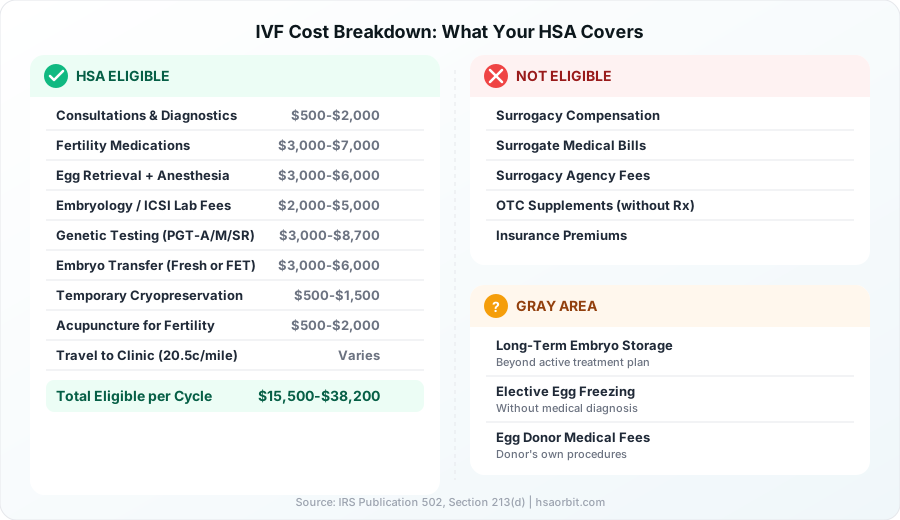
Nearly every line item on your fertility clinic invoice qualifies as an HSA-eligible expense. Here is the complete breakdown:
| Expense Category | Specific Items | HSA Eligible? |
|---|---|---|
| Initial Consultation | Fertility specialist visits, diagnostic workups, semen analysis | Yes |
| Diagnostic Testing | Blood work, ultrasounds, HSG (hysterosalpingography), hormone panels | Yes |
| Medications | Gonal-F, Follistim, Menopur, Cetrotide, Lupron, Ovidrel trigger shot, progesterone | Yes |
| Egg Retrieval | Retrieval procedure, anesthesia, facility fees | Yes |
| Embryo Lab Work | ICSI, assisted hatching, embryo culture, embryology fees | Yes |
| Genetic Testing | PGT-A, PGT-M, PGT-SR (preimplantation genetic testing) | Yes |
| Embryo Transfer | Fresh transfer, frozen embryo transfer (FET), monitoring | Yes |
| Temporary Storage | Egg, sperm, or embryo cryopreservation for immediate use | Yes |
| Travel | Mileage to clinic (20.5 cents/mile in 2026), lodging up to $50/night | Yes |
| Acupuncture | Acupuncture sessions for fertility enhancement | Yes |
| Surrogacy | Surrogate compensation, surrogate medical bills, agency fees | No |
| Long-Term Storage | Indefinite embryo/egg storage beyond active treatment plan | Gray Area |
Pro Tip
Fertility medications alone can cost $3,000 to $7,000 per cycle. Drugs like Gonal-F, Follistim, and Menopur are all HSA-eligible when prescribed by your fertility specialist. Pay for them directly from your HSA debit card or reimburse yourself after payment. Use the HSA Orbit Expense Checker to verify any specific medication or procedure before you pay.
Using Your HSA for a Spouse's IVF (Even on a Separate Plan)
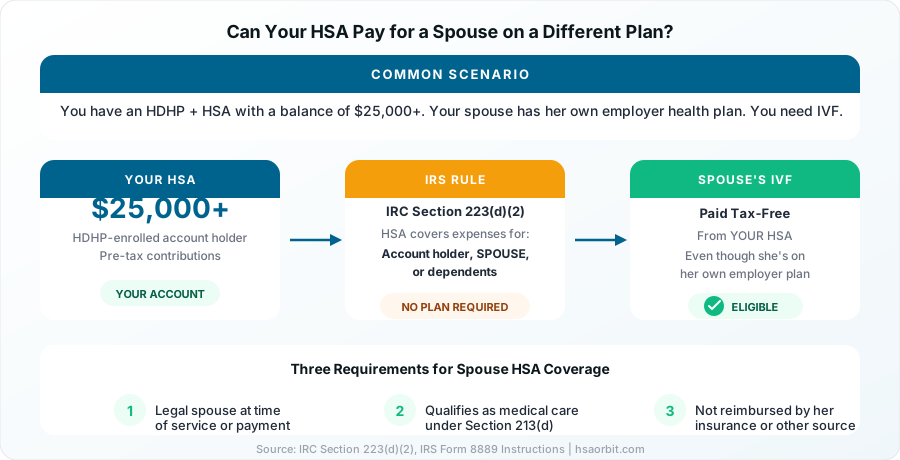
This is one of the most misunderstood rules in the entire HSA landscape, and it catches thousands of couples off guard every year. Here is the scenario: you have an HDHP with a well-funded HSA, but your spouse carries her own health insurance through her employer. She is not listed on your plan at all. You are about to start IVF. The question is whether your HSA can pay for her fertility treatments.
The answer is yes. Your HSA can pay for your spouse's qualified medical expenses regardless of whose insurance plan covers her.
The IRS Rule
IRC Section 223(d)(2) defines qualified medical expenses for HSA purposes as amounts paid for medical care under Section 213(d) for:
- The account holder (you)
- The spouse of the account holder
- Any dependent of the account holder
The IRS does not require your spouse to be enrolled in your HDHP. She does not need to be an "eligible individual" for HSA purposes. She does not even need to have health insurance at all. The only requirements are:
- She is your legal spouse at the time the medical services are received or the expenses are paid
- The expense qualifies as medical care under Section 213(d)
- The expense is not reimbursed by her insurance or any other source
The Form 8889 instructions confirm this: "Distributions from an HSA used exclusively to pay qualified medical expenses of the account beneficiary, spouse, or dependents are excludable from gross income."
Important
There is one critical rule to follow: you can only use your HSA for the portion of your spouse's IVF costs that her own insurance does not reimburse. If her plan covers part of the IVF cycle, your HSA can only pay the remaining balance (deductibles, copays, coinsurance, and non-covered services). Double-dipping on the same expense would make the distribution non-qualified.
Why This Matters for IVF
Consider a common scenario. You have been contributing to your HSA for several years and have built up a balance of $20,000 or more. Your spouse's employer plan does not cover IVF, or it covers only diagnostic testing but not the actual treatment cycles. Your HSA can step in and pay for her entire IVF journey, tax-free, as long as the expenses are not reimbursed elsewhere.
This is especially valuable when:
- Your spouse's plan excludes fertility treatments (which many plans still do)
- You live in a state without an IVF insurance mandate and her employer is not required to cover it
- Her plan covers IVF partially, and your HSA covers the remaining out-of-pocket costs
- You have been strategically building your HSA balance in anticipation of treatment
What If Both Spouses Have HSAs?
If both you and your spouse each have your own HDHP and your own HSA, you can coordinate. Both HSAs can pay toward the same IVF cycle, as long as the total reimbursements do not exceed the total unreimbursed expenses. For example, if IVF costs $25,000 and insurance covers $5,000, the remaining $20,000 can be split between both HSAs in any proportion.
The Tax Savings Math: How Much Does an HSA Save on IVF?
The triple tax advantage is powerful on its own, but it becomes extraordinary when applied to a large expense like IVF. Here is how the math works with real numbers.
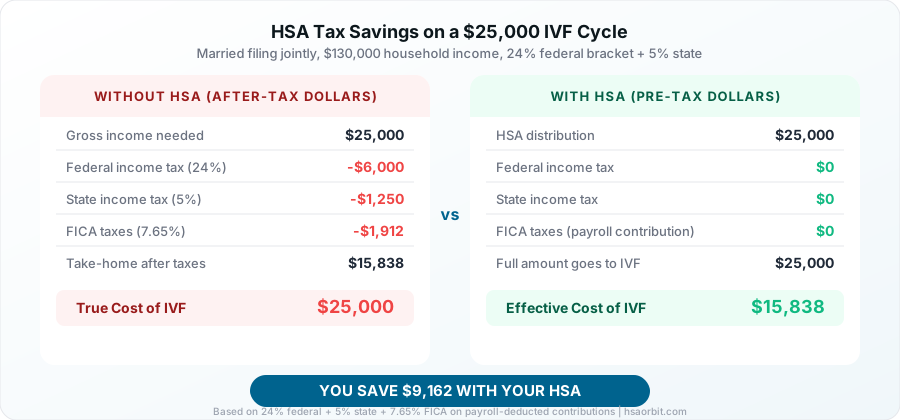
Example: $25,000 IVF Cycle, Married Filing Jointly
Assume a household income of $130,000, putting you in the 24% federal tax bracket, with a 5% state income tax rate.
Without an HSA (paying with after-tax dollars): You earn $25,000, pay taxes on it, then use what is left to pay for IVF. The effective cost is the full $25,000 plus the opportunity cost of lost tax savings.
With an HSA (paying with pre-tax dollars):
| Tax Savings Component | Rate | Savings on $25,000 |
|---|---|---|
| Federal income tax avoided | 24% | $6,000 |
| State income tax avoided | 5% | $1,250 |
| FICA taxes avoided (if contributed via payroll) | 7.65% | $1,912 |
| Total tax savings | 36.65% | $9,162 |
That is over $9,000 back in your pocket on a single IVF cycle. If you go through two or three cycles, the cumulative savings are substantial.
Pro Tip
To capture FICA savings (Social Security and Medicare taxes at 7.65%), your HSA contributions must come through payroll deduction, not direct personal contributions. If your employer offers payroll HSA deductions, always use that route. Direct contributions still save you federal and state income tax, but you miss the FICA benefit. See our guide on HSA tax strategies for the full breakdown.
The Medical Expense Deduction Alternative
If your total medical expenses exceed 7.5% of your adjusted gross income, you can deduct the excess on Schedule A. For a household AGI of $130,000, the threshold is $9,750. A $25,000 IVF bill would let you deduct $15,250, saving $3,660 in federal taxes at the 24% bracket.
Compare that to the HSA approach: $9,162 in total tax savings versus $3,660. The HSA wins by a wide margin. It also avoids the need to itemize deductions, which many filers cannot do because the standard deduction ($30,000 for married filing jointly in 2026) often exceeds their total itemized deductions.
HSA vs. FSA for Fertility Treatments
If your employer offers both an HSA and an FSA (or if you are choosing between the two), the HSA is nearly always the better vehicle for IVF expenses. Here is why:
Rollover: HSA funds roll over indefinitely. FSA funds expire at year-end (with a small grace period or $660 carryover at best). Since IVF planning often spans multiple years, the rollover advantage is decisive. For a complete comparison, see our HSA vs. FSA guide.
Contribution limits: The 2026 family HSA limit is $8,750. The FSA limit is $3,300 per person. A couple with two FSAs reaches $6,600, which still falls short.
Retroactive reimbursement: You can pay for IVF out of pocket today and reimburse yourself from your HSA years later, with no time limit. FSAs require you to incur and claim expenses within the same plan year.
Investment growth: HSA funds can be invested in mutual funds and ETFs, growing tax-free. FSA funds sit in a non-interest-bearing account.
Good to Know
There is one narrow scenario where an FSA has an advantage: front-loaded availability. If your IVF cycle starts in January and you elect $3,300 in FSA contributions, you can access the full $3,300 immediately, even before you have contributed a single paycheck. An HSA only lets you spend what you have deposited so far. For this reason, some families use both an FSA (through a spouse's employer) and an HSA simultaneously, layering the front-loaded FSA access on top of the larger HSA balance.
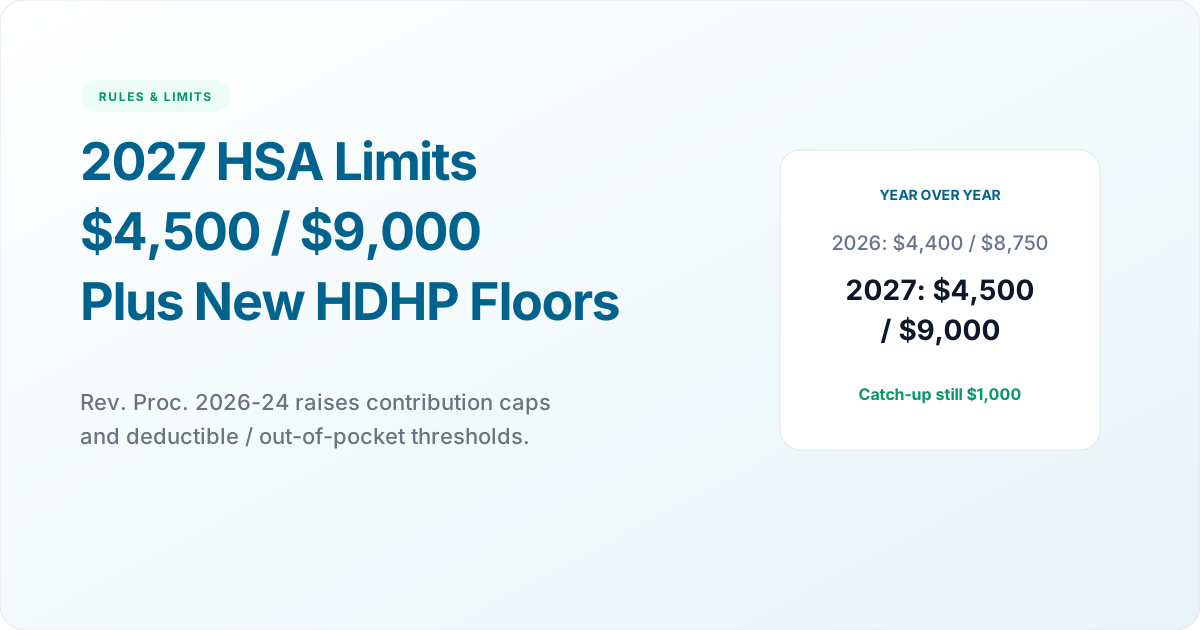
| Coverage Type | 2026 Limit |
|---|---|
| Self-only coverage | $4,400 |
| Family coverage | $8,750 |
| Catch-up contribution (age 55+) | +$1,000 |
Source: IRS Revenue Procedure. Limits include employer contributions.
Building Your IVF Fund: Multi-Year HSA Strategies
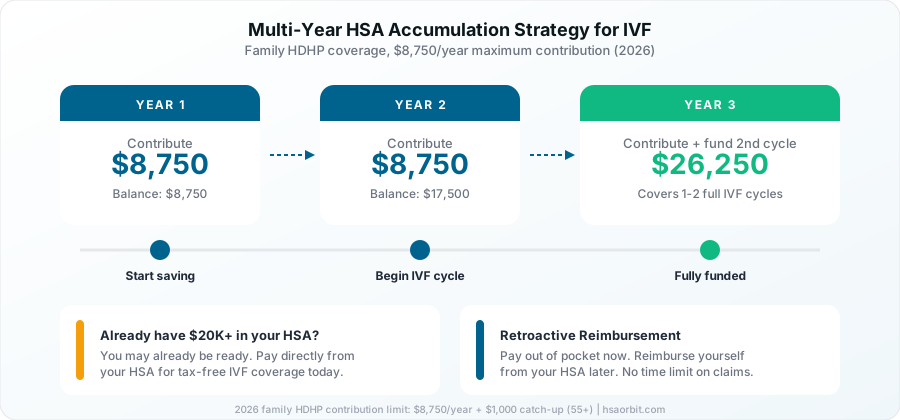
Because IVF costs typically exceed a single year's HSA contribution limit, building your HSA balance over two to four years before treatment gives you the maximum tax advantage.
The Two-Year Family Plan
If you and your spouse know IVF is in your near future, switch to family HDHP coverage (if you have not already) and max out your HSA contributions starting immediately.
| Year | Annual Contribution | Cumulative Balance | Notes |
|---|---|---|---|
| Year 1 | $8,750 | $8,750 | Max family contribution |
| Year 2 | $8,750 | $17,500 | Begin IVF cycle mid-year |
| Year 3 | $8,750 | $26,250 | Fund a second cycle if needed |
After two years of maximum family contributions, you have $17,500 in pre-tax dollars ready to deploy. That covers the base cost of one full IVF cycle at most clinics. If your balance already exceeds this amount from prior years of saving (as many long-term HSA holders find), you may be ready to start immediately.
The Retroactive Reimbursement Strategy
This is one of the most powerful and least-known HSA techniques. There is no time limit on HSA reimbursement. You can:
- Pay for IVF out of pocket today (using a credit card for points, if you like)
- Keep the receipts
- Let your HSA balance grow and invest tax-free
- Reimburse yourself from the HSA months or even years later
This approach works especially well if your HSA balance is currently below what you need. Pay out of pocket now, continue maxing contributions, and reimburse yourself once the balance is sufficient. You get the tax deduction on the contributions AND the tax-free withdrawal for the reimbursement. Use the HSA Orbit Growth Simulator to model how your invested HSA could grow before you trigger the reimbursement.
Important
To use the retroactive reimbursement strategy, you must keep detailed records. Save every itemized receipt, explanation of benefits (EOB), and clinic invoice. The IRS can request documentation at any time, and there is no statute of limitations on HSA distributions.
If You Already Have a Large HSA Balance
Some HSA holders have been contributing for years and have accumulated $20,000, $30,000, or more. If this is your situation, your HSA is already a powerful IVF funding source. You do not need to wait or build up more. Simply pay your fertility clinic directly from your HSA, and the entire distribution is tax-free as a qualified medical expense.
What Fertility Costs Are NOT HSA Eligible?
While IVF itself is covered, certain related expenses fall outside the IRS definition of qualified medical expenses:
Surrogacy Expenses
The IRS does not consider surrogacy costs to be qualified medical expenses for the intended parents. A 2025 IRS private letter ruling confirmed that while a taxpayer's own IVF-related expenses qualify, the medical expenses of a surrogate do not. This includes surrogate compensation, the surrogate's medical bills, agency fees, and legal costs related to the surrogacy arrangement.
Indefinite Embryo or Egg Storage
IRS Publication 502 allows "temporary storage of eggs or sperm" as a qualified expense. The key word is "temporary." Storage that is part of an active treatment plan (storing embryos between a retrieval cycle and a planned transfer a few months later) clearly qualifies. However, long-term, indefinite storage for potential future use becomes increasingly questionable. Some HSA administrators flag annual storage fees after 12 months. A Letter of Medical Necessity from your fertility doctor can help support ongoing eligibility.
Elective Egg Freezing (Without Medical Diagnosis)
Egg freezing for medical reasons (such as fertility preservation before cancer treatment) is HSA-eligible with a Letter of Medical Necessity. Purely elective "social" egg freezing, where there is no underlying medical diagnosis, is a gray area. The IRS has not issued definitive guidance, and HSA administrators vary in their policies. If you pursue elective egg freezing, get a letter from your doctor tying the procedure to a medical rationale.
Non-Prescription Supplements
Over-the-counter fertility supplements (CoQ10, DHEA, prenatal vitamins without a prescription) are generally not HSA-eligible unless your doctor writes a prescription or Letter of Medical Necessity. With a prescription, prenatal vitamins may qualify.
Documentation Tips for IVF HSA Claims
IVF generates a mountain of paperwork. Keeping organized records protects you if the IRS ever questions an HSA distribution.
What to save for every IVF expense:
- Itemized clinic invoices showing each procedure and its cost
- Pharmacy receipts for fertility medications (with drug name, date, and amount)
- Explanation of Benefits (EOB) from any insurance that partially covers treatment
- A Letter of Medical Necessity from your fertility specialist (especially for gray-area expenses like extended storage or egg freezing)
- Mileage logs if you claim transportation to and from the clinic
- Lodging receipts if you travel for treatment (eligible up to $50 per night per person)
Pro Tip
Create a dedicated folder (physical or digital) for your IVF HSA documentation. Label each receipt with the date of service, the provider name, and the HSA distribution amount. This takes five minutes per expense and can save you hours of stress if the IRS requests verification years later.
State IVF Insurance Mandates and Your HSA Strategy
Your state's insurance laws directly affect how much of your IVF costs your HSA needs to cover. As of 2026, a growing number of states require insurers to cover fertility treatments:
States with comprehensive IVF mandates include California (effective January 2026), Connecticut, Colorado, Delaware, Illinois, Maryland, Massachusetts, New Jersey, New York, and Rhode Island. In these states, your insurance may cover a significant portion of your IVF cycle, and your HSA would cover deductibles, copays, coinsurance, and services the mandate does not include (such as additional cycles beyond the mandate limit or PGT testing).
In states without mandates, your insurance may exclude fertility treatments entirely. In that case, your HSA becomes the primary financial tool for IVF, making the multi-year accumulation strategy critical.
Check RESOLVE's state-by-state mandate database to understand your state's specific requirements.
Good to Know
The October 2025 executive order created a pathway for employers to offer standalone fertility benefits as "excepted benefits," similar to dental and vision plans. Combined with the EMD Serono medication discount program (up to 84% off list prices for Gonal-F, Ovidrel, and Cetrotide), your out-of-pocket IVF costs may be lower than you expect. Always check what employer benefits and manufacturer discounts are available before calculating your HSA needs.
Frequently Asked Questions
Plan Ahead, Save Thousands
IVF is one of the largest medical expenses a family can face, but your HSA turns it into a powerful tax savings opportunity. Whether you are just starting to explore fertility treatments or you are ready to begin your first cycle, the steps are clear: verify your HSA balance, confirm your spouse's eligibility for HSA-funded expenses, document everything, and take full advantage of the triple tax advantage that makes your HSA the most tax-efficient way to pay for fertility care.
Use the HSA Orbit Contribution Calculator to plan your contributions, and check the Expense Checker to verify any specific fertility cost before you pay. Every dollar routed through your HSA is a dollar that avoids taxes completely.